Monday, May 11, 2009

low tide at sungei buloh wetland reserve


so, we know at high-tide, we can see the tree-climbing crabs on the trees, the mud-skippers are also onto something that keep them afloat and the monitor lizards tend to be moving on the tracks rather than on the mud-banks.

what then would you see when the tide is down?

i used to prefer going to sungei buloh wetland when the tide was out. because all my previous sightings of the otters (until the last one) were made when the water level in the river/sea was low. that was the reason for my preference (of going to sungei buloh at low tide).


the staff at sungei buloh also concur with my observation. one of them told me that the otters usually make their appearance when the tide starts to go down. the three places where i have seen the otters are the sandspit off platform 1, near the mouth of sungei buloh besar and the pond after station 5.


at low tide, the crocodiles look-alike can be found on the muddy banks of the rivers stalking their prey. the monitor lizards appear to be more active at low tide or is it because they are more visible at that time?

the stray dogs tend to be seen more at low tide. i usually see them, sometimes as many as ten of them, at low tide near station 5. they move to the other parts of the reserve when the water level rises.


when the water level is low, the bigger fish become more visible. at high tide, they have more places to hide, so they can be anywhere but at low tide, they keep to the edge and because it is shallow at that time, you can see lots of them. i can identify only the tilipias and the milk fish. the other big fish, i not so sure of their species.


what about the birds, you may ask. this fellow goes to a bird sanctuary and he looks at everything except the birds. when the tide is high, the birds, especially the cattle egrets stay on the trees but when the tide is low, they come down to the mud banks and even the river beds.


Sunday, May 10, 2009


mother's day


my two daughters and my elder girl's fiance ian surprised their mother/future mother-in-law with a floral bouquet delivered to her working place on friday, 8 may 2009. ivy had called the fareastflora.com at thomson road from melbourne to make the order.

when told by the office staff that there was a floral basket in the office for her, my wife thought that the office staff were trying to pull her leg. in spite of repeated messages from the office, she refused to believe it was for her. 'what's the occasion? my birthday's in january'. finally, when she looked at the words on the delivery order, she was overjoyed by the gesture from melbourne.


happy mother's day to all mothers.

Saturday, May 9, 2009

where can you catch real longkong fish?


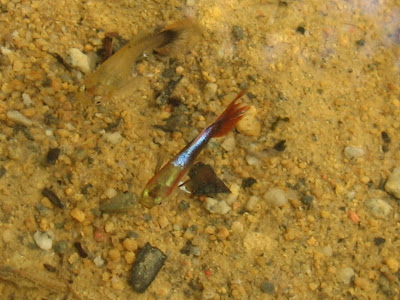
this was the type of fish we used to catch in the stream that ran beside our kampong house. when we first moved into the kampong, it was a natural stream, with a sandy bed and plants growing on both sides of the stream. sustenance for the guppies came in the form of tubifex worms which were plentiful in the stream.

in later years, they converted it into a concrete drain. the worm population was reduced to small lumps of them found between the gaps of the drain. the catfish, fresh-water eels and bigger fish gradually disappeared but the guppies were still around, though in smaller numbers.

i also remember going to a bigger and wider stream that ran outside the old police academy and the singapore polo club to catch guppies and another species which we children referred to as 'satay' fish; no, it is not the dried, crispy kind that you buy from tan kim hock in melaka. it appears to be a bigger version of the guppy and it has streaks of silver on its body.

when my two girls were younger - the elder one in her early teen and the younger one in her pre-teen - i would take them once in a while to the drain near novena terrace to catch the same kind of longkang fish that i caught when i was a kid in the stream next to my house.

there are still quite a few places in singapore where you can take your young children to catch longkang fish, lawfully, for free. in fact with the improved state of cleanliness in our waterways including drains, there should be more places where these fish can survive.

definitely, no catching of fish at the many reservoirs or the steams leading into them or out of them unless you want to risk a fine. (the above pictures of guppies were taken at the macritchie reservoir.)

it is not advisable to go down into canals to do this because of the inherent dangers. most canals have forms of waterlife, including guppies and bigger fish. however, they tend to be deeper and there is the danger of flash flood or a sudden rise in the water level.

a more dignified and safer way of experiencing this is to take your children to one of the many fish farms in the lim chu kang, sungei tengah and yishun areas where for $5, your children can try to capture as many fish as they can, with some assistance from mom and dad. (i have seen grown-ups going into the 'longkang' with a scoop to catch the fish. so, it is not so dignified, after all.)

you can read more about longkang fishing in this posting by seenthisscenethat.


so, where can you catch longkang fish the authentic way? i have caught some in the drain (above picture) along kranji way. i have seen longkang fish in the drain near the former national institute of education along bukit timah road.

this blog post has a number of pictures of the dad showing sonny how to catch longkang fish in a drain near cedar girls' school.


in fact, in any stream or drain today where the flow of water is continuous you are more than likely to find the longkang fish (guppies) surviving in it. it is not like those days in the 60s where the water in some drains was putrid. even if there was a constant flow of water, no ordinary living things would have survived in that kind of water.

Friday, May 8, 2009

what causes the fuse of the fridge to keep tripping?


for the past two days, i have been grappling with a household problem - my whirlpool fridge had decided to go on strike. i came home on tuesday evening to a darkened flat. it was not in total darkness as the staircase light was still on. i only realised there was a trip when i tried to switch on the kitchen's light. i tried a few other switches to confirm that it was a trip.

normally, when i go to the switchboard and flick the affected switch, things will get into motion. this time nothing happened. rather the switch kept returning to the 'off' position. the conclusion - one of the appliances had short circuited. my prime suspect was the fridge. i switched it off and then went back to the switchboard. true enough, it was the culprit.

i called my friend nah for advice. the next step was to replace the fuse in the plug head. i have a stock of used but working fuses. after i had put in a 'new' fuse, the tripping stopped but the fridge was still dead - the lights were off and the there was no sound from the motor and the fan.

the next day i decided to seek 'professional' help. i called my regular electrician, the one who services my air conditioners. he had helped me fix a fault with the same fridge before. he came checked and told me to get the agent's serviceman because the fault was with 'some internal wiring'.

sometime after he had left, i was moving some of the items from the freezer to a mini fridge in my room, when it suddenly came to life - the lights came on and the motor started humming. i thanked my lucky star for the saving on the repair bill.

then in the middle of the night it happened. the air-conditioner in my room stopped working. i got up to check and found out that the fuse of the fridge had tripped again. i switched off the fridge, and electricity to the other points was restored.

the next morning i called whirlpool south-east asia and that afternoon, the serviceman came with the necessary spare-part to fix the problem. the serviceman explained to me that it was the faulty heater that was causing the trip.


the fridge goes into a defrost mode once every eight hours. during this cleaning period, moisture or water may get into the heater, if there is a crack in it, and this will cause the electricity to trip.

once the faulty heater was replaced, the fridge starting working again. the repair bill - about $200.

the trouble that comes with a fridge that has stopped working is the food, especially in the freezer compartment, may go bad. afraid that contamination might take place, i cooked most of the meat in the freezer. so, yesterday evening we had a big pot of bak tuk teh and steamed egg with minced meat.

Thursday, May 7, 2009

kopi sua or bukit brown cemetery


the bukit brown cemetery was named after a british ship owner called george henry brown. he bought the area and called it mt pleasant. subsequently, the land was bought over by ong kew ho and the hokkien huay kuan. the government took over most of the land in 1919 and opened it as a public burial ground in 1922.

to the chinese, it is known as kopi sua (coffee hill). it must have been difficult for the locals to call it brown. in chinese, the colour brown is coffee. that was how it came to be called kopi sua.

on monday, we went to explore the bukit brown cemetery, one of the oldest chinese cemeteries in singapore. as it rained a bit while we were there, we did not get to move around very much. with one indian and two chinese, whose knowledge of mandarin can be best be described as 'half past six', it was a mission half lost because we could not read most of the inscriptions on the tombstones.


nevertheless, with some guesswork and by asking the cemetery workers, we did learn a thing or two. although it was considered a hokkien cemetery, there were chinese belonging to other dialect groups like cantonese and teochew, buried at the brown cemetery.

the year of death given in chinese does not correspond to the gregorian calendar. for example, if the year of death is stated as '32', it will translate to the year 1943 in the gregorian calendar. you add 11 to '32' to get 43, so 1943.

a number of graves were adorned with statues of two foo dogs, a male and a female. the male on the right holds down a ball. the ball symbolizes man's authority over the affair of his family. the female on the left holds down a kitten. the kitten symbolizes the woman's raising of children and household management. together these symbols mean that this relationship remain after death.


quite a number of the mounds were actually two-in-one: graves of husband and wife. there was one where the wife was buried in 1938 and the husband, thirty years later, in 1968. according to my friend jason, gold letterings on the tombstone indicated a man's grave and letterings (or rather chinese characters) in red meant it was a woman's grave.


traditionally, chinese tombstones were often made, and deployed, before the person was dead. the custom of using red lettering to let people know that the person named on the tombstone was actually still alive does not apply anymore. in the past, once the person died, the red letters would be repainted white.

at bukit brown cemetery, quite a number of the letterings on the tombstones were in red. does it mean that the person named is still around? no, it just means that the present generation and even the generation before are not aware of this tradition. red is just a common colour.

there was one grave which use is similar to those in the philippines: somebody appeared to have converted it into some living quarters. there were a number of dogs around and three singapore registered motorcycles were parked nearby but no one came out although the dogs were barking at us.


i just realised that where my father was buried - the cemetery along kheam hock road - it was part of the brown cemetery. all these years, i have been under the impression that my father's grave was located in the seh ong kongsi's cemetery.


photo taken during this year's qing ming festival

there have been talks of exhumation but up to now we have not received any notification of it.