Monday, September 20, 2010

fishing in lake benalla


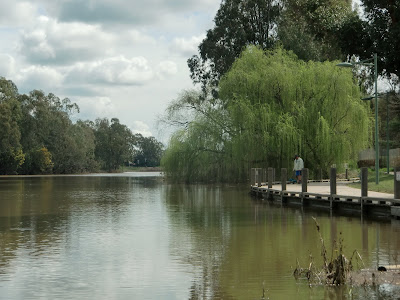
while visiting benalla in north east victoria, i noticed this man fishing with a rod and reel by the lakeside. the next day i got to talking with him and he educated me on the types of fish that abound in the lake and the river. most of the time he fishes in the lake but sometimes he moves to the lower reaches of the river. lake benalla is a man-made lake, created by the damming of the broken river.
golden perch, trench and carp are the common types found in the lake and that part of the river. in the faster flowing upper reaches of the river, the brown trout can be found. there are also murray cod in the broken river.


in some states in australia, you cannot take your fishing tackle and go fishing in the lakes, rivers or seas without a licence. a two-day victoria state fishing licence costs $5.50; a one-month, $11.00; a one-year, $22.00; and a three-year, $60. i understand there is also a minimum legal size for some fish that you catch with a rod and reel and other devices. different size limits apply to different fish. again, this may vary from state to state. if your catch does not meet the minimum size, you have to release it.


the lone angler caught four fish that morning. he told me that the day before he had landed twenty fish. what did he use as bait? i was surprised to learn that he used bread as bait. he broke off a small piece of white bread and pressed it onto the small hook. the small fish would nibble at the bread but the big ones would grab the whole thing and that was how they would be caught. as he did not have a marker or indicator on the line outside the water, on windy days, it was difficult to ascertain the movements of the line.


when asked what he would do with the bigger fish, the two carps, the solitary fisherman told me that he would bin them. i thought it was a waste until i found out later that carps were not supposed to be returned to the water. the state of victoria has declared the carp a noxious fish "which makes it an offence to possess, transport or release live carp, or use live carp as fishing bait". the declaration of 'noxious' fish does not mean that the species cannot be fished for, or eaten.

later in the evening, when i mentioned that we had been to the mornington peninsula, a friend told me that we should have tried fishing in the sea off portsea. according to him, you could catch whiting, flathead and snapper in that part of the sea. however, the experience of ian, my son-in-law, and some of his church friends, did not suggest that it was a fruitful (or fishful) or interesting activity. they had spent the whole night shivering in the chilly condition and the next morning, returned home empty handed.

Saturday, September 18, 2010

road users who spoil your day


driving is a much more pleasant experience here in surburban melbourne even though i am not as familiar with the place as singapore.

surprisingly, the majority of the drivers in melbourne try to keep within the speed limit. much unlike singapore, where, when you take the taxi from the airport to the city, you get the impression that nobody takes the speed limit seriously.

i like to think of the use of the indicators (signal lights on the car) as an indication of the level of courtesy. in singapore and malaysia, two countries where i do most of my driving, the indicators are used sparingly. maybe, they should sell cars that come without signal lights because they are more ostentatious than functional.

in singapore, maybe 3 out of 10 will use the indicator to signal their intention to turn; in melbourne, the majority, like 9 out of 10, signal.

here in melbourne, the drivers are more predictable. if they move to the left lane, invariably, they will make a left turn; if they move and stay on the right, then they will turn right. in singapore, in many cases, you know of the other drivers' intention only at the last minute.

of course, here in melbourne, you do find recalcitrant drivers who ignore the red lights and those who treat the public roads as a race track but the number of such misdemeanors is much less than back home.


the following are the types of road users back in singapore who are a bane to other road users:

he thinks the numbers 50, 60, 70, 80 or 90 on the signboards denote the minimum speed.

when he wants to exit from the expressway, he has to get as close to the exit as possible before making a dash into the left lane.

the signal light is to be used only in a situation when he may be in danger of being hit by a vehicle from behind. or, it is to be activated, as an afterthought, when he is in the midst of making a turn.

he thinks he is very smart to move ahead of everyone in a queue and bullies his way into a gap in the queue.

the battery life is more important than a human life. that may explain why he uses the signal light sparingly and also why he does not switch on the headlights before 7.00 p.m.

he thinks he is a skilful driver because his lorry/cement mixer is travelling faster than all the cars on the road or the expressway. (i overheard this young man boasting about his uncle, a lorry driver, who overtakes everybody, except the police, on the road.)

he chooses to ignore the advice to switch on the headlights while driving in a tunnel.

he does not need extra lighting, even when it is cloudy or when visibility is poor, like during a heavy down-pour.

he thinks he is a skilful driver because he is able to cut across three lanes to get to the exit lane at the last minute.

he considers himself very smart because he has ignored the red light and beaten the two-second allowance before the vehicles in the adjacent road start moving off.

Thursday, September 16, 2010

benalla - one street town
in north east victoria

on tuesday, i visited two of the towns affected by the floods in the first week of september 2010. of the two, i much prefer benalla to shepparton. both are located in north eastern victoria. the two towns are 60km apart. the lake (above picture) of the rural city of benalla was created in 1973 by damming the broken river. during the recent flood, the water level in the lake reached up to the top of the supports.

a friend who accompanied us on the trip, a singapore-born permanent resident, described benalla as 'a one street town where you cannot get lost'. in spite of its smallness when compared to shepparton, the fifth largest city in the state of victoria, benalla has got more than you can imagine.


benalla, which has the status of a rural city, has plenty of colours. the sky is clear and blue and the sunset is fiery red. it also has the title of 'the rose city' but because the rose plants in the rose garden were not in bloom, i did not take any picture. even the sunrise is equally brilliant.


this strikingly modernist building is the benalla art gallery. it is located in the botanical gardens (is it not botanic gardens?), near the town's famous rose garden. it has a cafe that overlooks the lake. many visitors like to come here to sip coffee or wine or have lunch while enjoying the unique and beautiful setting.


ths ceramic mural also found by the side of the lake has been called 'the largest community artwork in australia". according to the tourist brochure 'the sculptural piece was inspired by the works of spanish architect antonio gaudi and was created by the local community with the assistance of some of australia's best potters'.


this unique archway leads to a carpark and an indian restaurant. you do not see many 'black hair' in benalla. looking through the telephone directory, i could not find a single chinese or asian name. however, there are two chinese restaurants in this town with a population of 9000. according to my daughter, if the food is popular with the locals (meaning, australians), then it means it will not suit the chinese.

it is a quiet town, good for a short stay. when i went on my morning walk at 6.30 a.m., there was hardly anyone on the road. the night before, after having had our dinner at a local hotel, we found the whole street deserted at 9.00 p.m.

Tuesday, September 14, 2010

places we visited in melbourne


for three of them in this group of nine, this was their first visit to melbourne and out of these three, one of them is an australian permanent resident. one thing that was borne out during this trip was that when you are older, enjoying the company of your travelling companions was more important than taking in all the sights. at swanston street, the men were content to just sit outside a cafe enjoying a cup of long black while the women went shopping at davy jones. melbourne in early spring still retains the chill of winter, with temperature hovering around 13 degrees celcius.


from our service apartments at william street, we walked the 800m to queen victoria market. market days are 5 days a week, except for mondays and wednesdays. on most days, the market opens at 6.00 a.m. however, on sundays, it starts a bit later, at 9.00 a.m. although i have been to 'vic mart' several times, every visit is filled with a sense of anticipation: expectation of something new or something interesting. nevertheless, i will always look out for the iconic doughtnut van, which has been around for more than 50 years. the doughnut which cost 80cts during my last visit, now costs a dollar each.


a few of my friends, not members of this group, who have been to melbourne had complained about the long and winding trip to view the 12 apostles along the great ocean road. actually, if you want to see features like arches, stacks and stumps, you do not have to travel so far away from melbourne. at the sea, off portsea, in the mornington peninsula you can see these wonders of nature.

"The scenery at London Bridge was fantastic. White-foam waves throwing at the coastlines to form coastal features like outcrop of rocks along the coast. It was chilly cold at London Bridge....." as reported by the secretary for the trip

sorrento is about one and a half hours away from melbourne city. i have always enjoyed sorrento because of its italian name and our wonderful stay at hotel sorrento on our first visit to the peninsula. sorrento is described as a largely upper class seaside resort area but it is also a quiet seaside township in the off-peak months of the year. sorrento is the place where you can take the vehicular ferry to queenscliff. we had dinner at an italian restaurant in sorrento.

the t'gallant winery was also on our itinerary. the group did not show much interest in the vineyard as there was nothing much to see because the grapes had all been harvested. we, however, enjoyed the lunch of wood-fired pizzas at the winery. we had a bottle of wine to go with the food and only one person in the group bought a bottle of wine. from the winery, we moved on to the sunnyridge strawberry farm which is more popular during the strawberry picking season, between november and april.

i had told my group that we would miss out on strawberry and cherry pickings. we also would miss the tulip festival which does not start till 16 september.

we also drove to murray's lookout point at arthurs seat which afforded visitors panoramic breathtaking views of the mornington peninsula and beyond. on a clear day, you could even see the city skyline from the various lookout points at arthurs seat.

at the dandies, where we had lunch at miss marples, the ladies in the group bought souvenirs and cards. one of the men bought a wooden mandarin duck.

Sunday, September 12, 2010

mahatma gandhi's ashes

scattered in s'pore


small photos from national archives of s'pore


i was browsing for photographs of the old clifford pier when i came across these 3 interesting photographs. i just found it hard to believe that the ashes of the great mahatma gandhi were brought to singapore from new delhi via ipoh on a cathay pacific flight to be scattered in the sea off connaught drive.

prior to that, it was on public display for a week at the victoria memorial hall. on the first day, it was up for viewing up to midnight. on subsequent days, viewing stopped at 9.00 p.m. representatives from the main religious groups like hinduism, christianity, buddhism and sikkhism offered prayers. the muslim community offered prayers in their mosques.

on the day, the ashes were to be scattered, large crowds gathered outside clifford pier. rough seas prevented the ashes from being immersed from the big launch which brought them from the shore. the ashes had to be transferred to a smaller marine boat.

the indian government representative in singapore mr john thivy performed the ceremony. he poured the water from the ganges river into the urn containing the ashes, dipped the urn into the sea, took it out and scattered the ashes.

as mr thivy immersed the ashes, hundreds of people, in about 20 private chartered launches, joined in a mad rush to sip the water around as a last token of homage to mahatma gandhi.

the ashes of mahatma gandhi were split into many portions. most of the ashes were scattered in india but some were scattered overseas and singapore was one of those countries to receive the ashes.

the last scattering of mahatma gandhi's ashes was carried out this year (2010). his ashes, kept for decades by a family friend, were scattered off the coast of south africa on the 62nd anniversary of his death.

mahatma gandhi was assassinated by a hindu fanatic on 30 january 1948.