Saturday, April 17, 2010

suck harder! and it will come out


this trip to kuching, i ate something which i have not had for about 50 years. i ate siput sedut at a seafood restaurant in kuching. in singapore, we call these snails chut-chut. the last time i ate these river or mangrove snails was under the wayang stage at lorong sinaran when i was about 12 years old. those days, these snails must have been quite cheap. i remember we had to use the bent end of a safety pin to dig out the flesh.

in kuching, they call these snails 'the midnight kiss'. when my host started making smooching noises while sucking at the meat, i realise that the name was quite appropriate. initially, i had some problem getting at the flesh. my friend chided me for my lack of experience in kissing. she said the right way was to suck at the tail end before working on the front. i was able to eat more after receiving that instruction.

another person who was eating with us commented that cleaning and preparing the snails for the dining table entails a lot of work. it is so tedious that she seldom wants to cook this dish. i remember in those bygone days the chut-chut was not cooked this way. after cleaning and knocking off the tail end, the chut-chut was simply dumped into a pot of boiling water.

i remember the hawker who sold these snails also sold clams, vinegar crabs and some big mangrove snails which were as long as 8cm.

Wednesday, April 14, 2010

where was keramat habib ismail?


i have blogged about keramat habib noh located at palmer road, near the former singapore polytechnic. do you know that there was another keramat, bearing also the name of habib, located at upper bukit timah road, diagonally opposite the ford motor museum.

just before construction work started on the downtown line 2, i still saw evidence of faithfuls visiting the keramat. a new piece of yellow cloth was wrapped around the stone. wonder where they have moved it to.

a much frequented keramat which is said to be most potent in helping couple who desire children, or who have young children in poor health. syed ismail is described as an arab of great piety, who died about eighty years ago.

'singapore guide and street directory, 1969'

Wednesday, April 7, 2010

of sculpture and structure

picture from national archive of singapore


if you walk around kallang riverside park, you will come across a sculpture and a structure which remind you of the important part played by the kallang gasworks in the development of singapore.


the history of the kallang gasworks dates back to 1861 when piped gas first produced primarily for street lighting, and later for commercial and domestic uses. gas in those days was produced using coal as a feedstock. kallang gasworks' location by the bank of the rochor river was an ideal choice for easy delivery of coal by boat from neighbouring countries.

in 1958, kallang gasworks made headlines by being the first in the region to switch to heavy fuel as feedstock. the gasworks commissioned three modern catalytic heavy fuel oil gasification plants that were considered the most modern in the gas industry. naphtha, a clean and more efficient feedstock was introduced in 1966. this led to the phasing out of heavy fuel oil plants in 1980.

the completion of senoko gasworks in 1997 to meet the long term needs of singapore saw the relocation of gas production operations from kallang to senoko. kallang gasworks ceased operations on 23 march 1998 and the event was officiated by bg (ns) george yeo, then second minister fro trade and industry. kallang basin, the site where the gasworks used to stand as a prominent landmark of the area, has been earmarked for development.


the structure that stands as a reminder of the important part played by the kallang gasworks in the economic development of singapore is gasholder no.3

although the plants, equipment and structures in kallang gasworks have been dismantled, the supporting pillars and girders of gasholder no.3 have been preserved and erect ed on the plaza that lies in front of you.

commissioned in 1901, gasholder no.3 is the oldest remaining structure of the former kallang gasworks. the gasworks bear testimony to singapore's development from a fishing village to a cosmopolitan city.

refurbished in a shade of blue that is close to the original, this gasholder was preserved and installed at kallang riverside park as a tribute to kallang gasworks' contribution to singapore's economic development and a testament to our industrial past.

to-date, town gas remains widely used in singapore's homes, commercial establishments and industries since its inception over 140 years ago.
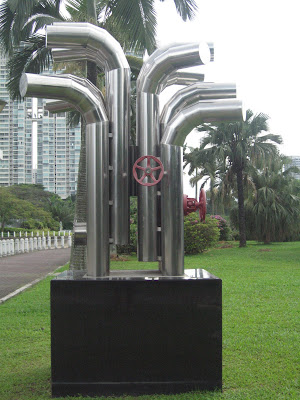


the sculpture is called 'spirit of kallang'. some of the materials used in the construction of this sculpture came from the old kallang gasworks.


spirit of kallang

this sculpture was official unveiled by minister for information and the arts and second minister for trade and industry, brigadier-general (ns) george yeo at the official retirement of kallang gasworks on 23 march 1998.

the spirit of kallang incorporates materials from kallang gasworks. its design symbolises the hardworking ethos and enduring spirit of the early pioneers of singapore who worked hard to establish a better life for future generations.

kallang gasworks (1861 - 1998) this sculpture was commissioned by singapore power limited and created by mr lim leong seng.

when i was doing a search on the internet, i discovered that my blogger friend has done a similar posting sometime ago.

Monday, April 5, 2010


the feature article in the life section of the straits times on 30 march makes me re-visit my photo album (of our switzerland tour) so as to share our experience. we actually visited three countries - switzerland, liechtenstein and italy. in the case of italy, it was just crossing from lugano in southern switzerland to tirano in italy. it is like crossing the causeway from singapore to johor bahru town.


ours was a 14-day tour - yes, a bit too long - and we travelled by train all the way, except for the return trip to lugano from tirano (in italy) when we were put on a postal coach. our starting point was zurich. this was our itinerary: zurich - st gallen -vaduz (in liechtenstein) -st moritz - tirano - lugano -lucerne - interlaken - montreux - zermatt/matternhorn - zurich.


we had no choice but to travel by train. driving would have posed a number of problems. first, you had to get used to driving on the right side, just like in the usa. the other problem was that the road signs and information signs were either in french or german. train is the better alternative.


we had to travel lighter than normal. each of us carried a slightly bigger than cabin-sized bag. as it was summer, we did not have to pack thick woollens, long johns, scarves and gloves. however, up in the mountains, it could get quite cold. the alps are covered with snow all year round.


from interlaken we took the cogwheel train to jungfraujoch, the highest train station in europe. of all the places in switzerland, zermatt left the deepest impression in me. i like zermatt, where you can see the majestic matterhorn, for its smoke-free environment - no petrol driven vehicles.

yes, if you do not enjoy being herded around in a conducted tour group, travelling by train on your own is a good way to see switzerland. you do not need two weeks; one week is enough for you to take in all the touristy places.

Saturday, April 3, 2010

04, 08, 18, 21, 24 and 369


scene of a gang fight - picture from national archive of s'pore


do these numbers make any sense to you? no, they cannot be toto numbers because the last one has 3 digits. there might have been other numbers but these were the ones i can recall. if you grew up during the 50s and 60s, you would have known someone who secretly or openly declared that he belonged to one of these numbered gangs. among my schoolmates and kampong kids were some who claimed allegiance to one of these secret societies.

each gang had its own so-called trade-marks. hand gestures and tattoos were two clear ways of identification. i was told that those who belonged to the 24 gang had two birds, i think they were either swallows or swifts, tattooed on one of their shoulders. i have heard of the butterfly gang - a woman gang in which members had the tattoo of a butterfly on their body.

gangland clashes were common in the 50s and 60s, even right up to the 70s. in the late 50s or early 60s, during the school holidays, i used to stay over with some relatives at dunlop street, a hotbed of gangland activities. a number of times, in the middle of the night, the silence would be broken by the sounds of bottles being smashed, shouting and heavy running footsteps. i was told not to venture out. these clashes, in which parangs, iron pipes and broken bottles were used, usually ended as quickly as they had started.

secret society members seemed to have scant respect for the living as well as the dead. in those dark days, fights at funerals and wakes were not uncommon.

my former neighbour in the kampong, who attended the same primary school as i, started young. at primary 3, he was already relieving me of my pocket money - ten cents each day. this went on for sometime and i cannot remember how and when it finally ended. extortion was one of the ways the gangsters derived some form of income. the other was collecting protection money from shops, hawkers, food stalls, bars and gambling dens.

this particular neighbour of mine ended up as a big-time gangster. i learnt that he was involved in a murder for which he was detained 'at the president's pleasure'.

some gangsters 'retired' after they had set up their own families but they continued to work in the background. they could still be called upon to help negotiate at 'settlement talks' but they would try to keep their hands clean by not getting involved in fights or clashes that might arise out of any failed talk.

not all gangsters were pimps or people who engaged in shady or underground activities. some held respectable jobs. these people would keep a low profile but their trade-mark - the tattoo - that they wore on their bodies might be a giveaway of their past connections.