Tuesday, May 19, 2009

spring water for washing motor vehicles


when i lived at hillview housing and development board (hdb) housing estate - now demolished - for a short while in the early 80s, i remember seeing across cars parked by the roadside, usually in the mornings or evenings, near the end of hillview avenue before it joined the former jurong road.


nothing unusual about cars parked by the side of the road except that the owners were seen collecting water from some source nearby, in the drain, to wash their vehicles. the water was clean and the supply of it was continuous. i did not have a car then, so i did not avail myself to this free car-wash.


with the developments and changes in the area, i thought that the flow of water would have been diverted or blocked completely.

today, i decided to deviate from my usual working route at bukit batok nature park. i decided to walk to the heavy vehicle car-park located along bukit batok avenue 2 east, which is actually a continuation of hillview avenue. i remember studying an old map of the area which showed the car-park as part of an old quarry.

it was a discovery walk for me. i discovered that there is still a constant supply of clean water for washing cars and buses from certain points by the sides of the drain around the heavy vehicle car-park.


i spoke to one man who was washing his toyota altis at the car-park and he told me that there is a non-stop supply of clean water from the outlets. day and night, water is gushing out from the ground.


the heavy vehicle car-park is located just before bukit batok nature park along bukit batok east avenue 2.

since i was nearby, i was tempted to wash my car there but changed my mind. after all, it costs 25 cents to wash it myself at my hdb car-park.

my car is not washed on a regular basis. i do not pay the man to wash my car in the car-park because i feel i would be abetting him in stealing water from the hdb. do you find out where he gets his water to wash your car? no, not from the 25-cent source. he has this device which he uses (illegally) to turn on the taps which the hdb cleaners are authorised to use.

Monday, May 18, 2009

chiam tau loti (french bread)


long before gardenia came onto the breadfast scene, our breakfast diet was a loaf of french bread which we called 'chiam tau loti'. the crust, when fresh, was so crispy that you could eat it on its own. it did not have such a fanciful name as baguette when you get it from delifrance. we bought ours from the bayi who came around on his bicycle or from the kampong coffee shop. each loaf - enough to feed the whole family - cost 25 cents.

the french bread in those days was leaner and longer. i was told you could not keep it for too long as it would turn stale after a day or so. anyway, our breadfast food did not get a change to reach that stage because it was always consumed within a day or rather, within a morning.

i liked, and still like, the two ends which my friend's daughter referred to as the 'elbows'. i think it is the crispiest part of the french bread.


like the hard biscuits (which i blogged about), i liked to eat it after dipping it in hot black coffee. you could also spread kaya and/or planta margarine - that came in ayellow metal can - on it. some children liked to spread a layer of margarine and then sprinkled white sugar on it.

when we became more 'affluent' in later years and could afford pricier food, we would still buy the chiam tau loti and dipped it in curry, especially chicken curry.

Sunday, May 17, 2009

what are they building in the canal?


this construction has kept me wondering. what are they building in the canal and what is its purpose?

looking at the pictures, can you guess the purpose of this structure across the bed of the canal.

the level of the water in this canal is not directly affected by the tides. most of the time the water flows along a shallow channel in the middle of the canal (the darker patch in the 1st and 3rd pictures). the water level goes up only after some continual rain or a heavy downpour.

before they started construction on this, i was not aware that there are fishes (of two different species) of about 12cm long in the water of the canal. it was only when the water was held back slightly and its level rose that i noticed the fish.

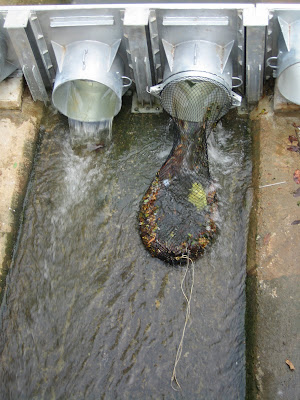
since chun see has answered the question on behalf of victor, i am showing the photo of the net that they secured to one of the outlets. over the weekend, the net has been filled to capacity.


did they build this so that the fish can have a race, taking up position behind the 12 holes, when the water level is high?


in these hard times, to make it easier for poor people like me to catch the fish?


to trap the flotsam and jetsam that is making its way to the sea along this canal?


to make the canal look a little bit aesthetically pleasing?

maybe you can think of other reasons for the building of this structure.

Saturday, May 16, 2009

chope! chope!


my australian friends, who were back here after a lapse of 15 years, were sitting down to have a meal at a food centre when they found 'complimentary' tissue packs on the table. already in awe over all the physical changes that had taken place since their last visit, they were about to be bowled over by this gesture - a packet of pocket tissue to clean up after the meal - when the 'chopers' appeared.

when i first ate at a food court in australia, i did it the singapore way: find some empty seats, plonk ourselves down and then go and order our food, with at least one person at the table to 'jaga' the seats. my australian friend told me that in his adopted country, they buy their food first and after that go look for a place to sit.

for sometime, i have been unaware that using a packet of tissue to reserve a seat has been a prevalent practice here. maybe, they do not do it in the heartlands. maybe, it is the office crowd that does it. i first saw it in practice when i had lunch at the foodcourt at the basement of sim lim square. i saw it again the other day at marina square.

wonder why people chope seats with a tissue packet? you would look silly carrying a tray and walking up and down, without a single empty seat in sight. maybe, we do not feel comforable sitting down for a meal with strangers, sharing a table? we want to be seated with our colleagues during our lunch break? it can be costly to chope seat with a mobile phone or a handbag.

you may say in australia or any other country they do not do it because the food centres are not so crowded. but it is not the accurate picture. the food places can get quite crowded at lunch time and you may have to wait for a while to get a seat.

Friday, May 15, 2009


making the dough and the pizza


so, you have made the pizza paste, what do you do with it? actually, it can be used as a pasta for spaghetti. but, when i cook spaghetti, i rather get the pasta that comes in a bottle....from the supermarket.

okay, i will now go on to write about making the dough and then the pizza. most people use plain flour but i prefer to use bread flour for the dough. nowadays, i use the instant dry yeast - the granules that come in a small packet. in the past, i would buy a block from cold storage supermarket and cut it to the right size.

while most people leave the smooth, shiny and elastic dough to rise for about two hours - until it is double its original size - i let mine rise for about eight hours or more. i leave it in a glass bowl and cover the top with a layer of clear polyethylene. this acts as a seal and prevents it from coming into contact with the outside air.


my one lot will give me between 24 and 30 pizzas, depending on the thickness of the crust. if i make the crust thinner, then i get more.

the first layer on the crust is finely chopped garlic soaked in olive oil. next comes the paste and then the rest of the ingredients which include cut big onion slices, pepperoni, ham, bacon, sausage, button mushroom and olive. the toppings will be mozarella cheese followed by grated pamesan cheese.