Sunday, January 31, 2010

cube sculpture quiz


1 at which reservoir can you find this solid cube?


2 what was the original name of this reservoir?


3 in which year was the expanded reservoir officially opened?


4 who declared it open?


The answers to all four questions can be found on the information board at the reservoir.

Friday, January 29, 2010

akin to durian


i have walked the prunus-petai trail at macritchie reservoir park so many times that i have lost count but today was the first time i saw the beans dangling from the petai tree. i have seen fresh petai sold at the market many years ago. it was in the days when the old kandang market extended onto the road. there was this malay man who would sell the petai from his 'bicycle stall'. he would usually be stationed in the middle of the road, nearer to campbell lane.


whenever i walk at bukit batok nature park and when i am near the disused quarry pond, i will be gazing at three of the trees, hoping to see the strings of beans. i have not seen any up to this day.

today, you can get the shiny petai seeds, sold in packet at sheng siong supermarket. each pack of about 50 seeds cost $2.80.


petai bears long, almost flat edible beans with green seeds the size and shape of almonds. the beans have a peculiar smell, which some people find offensive.


i have been told by my friend that eating petai is an acquired taste, just like eating durian - you either like it or hate it. sometimes it is very difficult not to use the race label when discussing food. i ask a number of singaporean chinese and none of them like the 'stinky bean' but from my malay friends, it is a different response. all of them seem to love eating sambal petai udang or sambal petai ikan bilis.


here's a link to a petai recipe.

Wednesday, January 27, 2010

19th century tombs at bukit timah rd


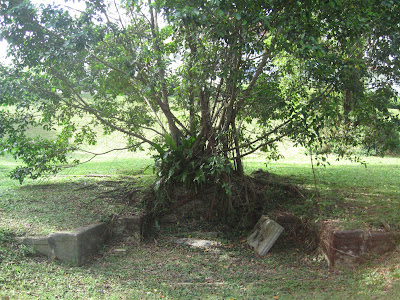
while looking for the candlenut tree at the eco garden, we did a bit of exploring on a sloping piece of land between the former singapore management university and the present jacob ballas children's garden.

we found at least three graves, two of which the tombstones are clearly seen but the tombstone of the third one has almost been wrapped up by the roots of a banyan tree. i had to get closer to read the inscriptions on the granite slab.

two of the graves were believed to have been constructed in 1842, making them one of the oldest chinese tombs still around. the other was built in 1888.

you can go to this blogsite to read more about the history of these tombs.

Tuesday, January 26, 2010

every indian must watch

caution: bad language used.

Monday, January 25, 2010

candlenut tree (buah keras)


the other day i went with my walking kaki to malcolm park to look for the candlenut tree. the small park next to the s'pore chinese girls' school was once designated a spice garden and my kaki was very sure that this tree existed in the garden. we looked at all the trees but could not identify the candlenut tree.

today, we went to the eco garden at botanic gardens to take photographs of two candlenut trees which are flowering. we did not see any fruit on either of the trees.


the candlenut is often used cooked in indonesian and malaysian cuisine, where it is called kemiri in indonesian or buah keras in malay.

each nut contains one or two waxy white kernels, and after suitable preparation, are widely used as a flavouring ingredient in indonesian and malaysian households.

the usual practice is to roast the nuts, crack them open and saute the kernels. these are then crushed with other ingredients like shallots, garlic and chilli to produce a mixture used in savoury dishes.

the nuts contain a toxin which make them unsuitable to eat raw; but, during cooking, the toxin disappears.

the nut is very oily and it has been used in the past to make candles and hence its name - candlenut.


the candlenut looks very much like the macadamia nut (above picture). both candlenut and macadamia go rancid easily. outside of this region, macadamia nuts are sometimes substituted for candlenuts. the flavour, however, is not quite the same, as the candlenut is much more bitter.


the candlenuts are sold in packs of 100g, 200g and 1000g at sheng siong supermarket. the smallest pack retails for 70 or 80 cents, depending on the brand.