Showing posts with label AROUND S' PORE. Show all posts

Sunday, December 5, 2010

the japanese cemetery park


the japanese cemetery park has been around since the 19th century, long before the japanese invaded singapore. it was gazetted as a memorial park in 1987.

'japanese brothel owner tagajiro fukaki donated 7 acres of his rubber plantation at chuan hoe avenue, off yio chu kang road, to be used as a burial ground for young japanese women who died in destitution. the british colonial government granted permission for this use on 26 june 1891. since then, it was used to bury japanese residents. during world war ii, the cemetery was used to bury japanese civilians and soldiers who lost their lives in the battlefield or to illness.

no one has been buried here since 1973 as this was one of the 42 cemeteries where burials were prohibited by the government. the japanese association of singapore maintains the park which is often visited by japanese students, residents and tourists.'


this is the prayer hall within the cemetery park. i had thought it was a shinto shrine. although the prayer hall is closed most of the time, if you peep in, you can see some statues of buddha at the front of the hall.

the cemetery park is well-maintained and there are quite a number of mature trees, including some fruit trees. there is an old lychee tree - designated an heritage tree - next to the prayer hall. the lychee tree is not able to bear fruit here because of the unsuitable climatic conditions.

these three slabs of stones were erected in memory of those who lost their lives during the pacific war. behind this memorial, buried in a hole which was sealed with concrete, were the ashes of dead japanese soldiers collected from the destroyed syonan chureito at bukit batok.


this is a statue of the hinomoto guardian deity. this memorial was built in memory of 41 japanese civilains who died in the internment camp at jurong while waiting for repatriation after the japanese defeat in world war ii.

one surprise find at the japanese cemetery park is this chinese grave of a chinese man. although my mandarin is rather inadequate, i can make out certain characters like 'hokkien' and 'heng hwa' inscribed on the tombstone. i was told that the tomb had been refurbished. it belonged to the a former cemetery care-taker who died more than 70 years ago.

strangely, this chinese tomb is different from one i came across in another website. could there be more than one chinese grave within the japanese cemetery?

Monday, November 29, 2010


the chureito at lorong sesuai

japanese soldiers leading some german soldiers to the chureito
(photo courtesy of my blogger friend peter)


a smaller version of the memorial at the japanese cemetery park

the 135 concrete steps


the bukit batok memorial


once in a while, when i am at bukit batok nature park, i will see a bus-load of japanese tourists alighting at the foot of the 135 concrete steps. if you do not know the history of the place, you may wonder: what is the attraction for this whole bus-load of tourists? are they here to see the mediacorp transmission towers at the top of the hill? or are they here to see the 'big book' - the bukit batok memorial? no, they are there for another reason.

after the war, the japanese consigned 500 australian prisoners of war to build a memorial to the japanese soldiers who died in the malayan campaign. the japanese commander lieutenant-general yamashita had chosen this site for the memorial because the fiercest battle in singapore was fought there, somewhere near the ford motor works.

the japanese memorial was known as the syonan chureito (syonan war memorial). it was a 13m high cylindrical wooden pylon with a brass cone at the top. the ashes of the japanese soldiers who died in the battle of bukit timah were buried there. not far behind it, there was another memorial - a 3m high wooden cross - dedicated to british soldiers who died in the same battle. there was also a small japanese shrine near the chureito.

what happened to the two memorials and the shrine? when the japanese surrendered in 1945, the returning british forces demolished the memorials and the shrine. according to one report, the wooden cross was destroyed inadvertently. another report said that the wooden memorial failed to withstand the elements of nature and the passage of time. today, if you go to the site, beyond the fence, you cannot see any trace of them.

my friend, who was a teenager during the occupation, had seen both the chureito and the wooden cross. he was working for the japanese military command then. every year, on new year's day and on the anniversary, he would be taken to the site to pay his respect - by bowing three times - in the direction of the chureito.


it was customary for japanese employers to take their local civilian staff to pay their respect at the chureito. in fact, the japanese authorities made it compulsory for the leaders of all the communities to pay homage at the chureito.

today, the 135 steps are the only reminder that at one time the presence of the japanese conquerors was very evident in this area. the original steps were rough and not so well aligned. today, there is an information panel, put up by singapore tourist promotion board, that gives a bit of history of the place.

the 13m obelisk was so high that it could almost been seen from bukit timah road. these days when the tourists visit the spot, it is only their imagination that will enable them to see the obelisk.

Saturday, November 6, 2010

left high and dry since 2001


like the river valley swimming complex, the yan kit swimming complex has been left high and dry since 2001. according to the records, the first public swimming pool in singapore is the one that used to be at mount emily park and yan kit followed soon after. actually, before yan kit was opened, there was another swimming pool - although a privately owned one - which was open to the public. i have blogged about it here. it was the haw par pool at pasir panjang.

a fellow blogger wrote about his memories of yan kit swimming pool here.


in fact, when haw par pool closed down, its waterpolo team, the tiger swimming club, sought and got permission to train at yan kit swimming pool. when i visited the disused swimming complex last week, i could three troughs - a deep one, with a three-metre diving platform, near the main entrance, a standard one in the middle and a shallow one, which must have been the wading pool, at the other end.


according to my friend who had his waterpolo training at yan kit, the place was packed with bathers and swimmers on weekends. some of the pool users from the nearby chinatown area were literally bathing in the pools. they would have a towel around their neck and all the time they would be rubbing their body with the towel. it was a good and cheap, though not hygienic, way to get a decent bath, which was something they could not get in their crammed cubicles in chinatown. the initial admission charge was 15 cents; just before it closed in 2001, the charge was $1.00.


just like mt emily swimming pool, there was one day each week set aside for the modest ladies who did not like to be seen in their swim costumes in public. however, on such tuesdays, the taking was usually much lower.

when attendances at public swimming pools started to dwindle in the late 70s, a number of public pools had to be closed down because of the high maintenance cost. besides river valley and yan kit, the others that were closed include bukit merah, jurong town and pandan garden. farrer park is now a private swimming pool. mt emily has disappeared totally.

however, that does not mean that the singapore sports council has stopped building swimming pools. there is a brand new one next to my block at the bukit panjang sports complex cum community centre. the admission charge is $1.50 for adults. i have yet to step into it.

Wednesday, August 11, 2010

indoor playground for small children


if you do not have young children or if your children are grown up, you may not be aware that such places exist. i first came to know of such facilities when i was in melbourne recently.

you would not step into such a place unless you have small kids to take care of. i was not aware that such a service was available in singapore until i was asked to accompany a grand nephew to fidgets at turf city. when my two girls were younger, we took them to ikea at sixth avenue, actus at sunset way and the macdonald's at serene house. (incidentally, actus at one time occupied the premises vacated by ikea at sixth avenue.) all these places had playroom with multi-coloured balls for toddlers to romp for free. nowadays, these indoor playgrounds are enjoying good business.


at fidgets, adults who accompany the children go in for free but the kids are charged $8 per entry for those who are below two years old and $15 for those between 2 and 10 years old. one accompany adult has to be there with the kid. the area set aside for 'little fidgets' has two small plastic cars and a small ball room.


for the bigger children, there is a bigger playing area in the form of an adventureland. still, sometimes adults have to climb in to rescue their little ones. the under 2s should be kept away from this area because the bigger ones tend to be rowdier. the area is carpetted and socks have to be worn at all times.


there is a cafe which serves drinks and snacks. however, the prices, to me, seem higher than those at starbucks - which i don't patronise anyway. you do not pay cash but instead use the same card issued to you upon entrance. the parents, especially the mothers, seem to find some respite while their little ones are playfully occupied.

if you go to this website, you can find a list of the indoor playgrounds distributed all over the island.

Wednesday, April 21, 2010

old building quiz
in the 50s and 60s, this building used to serve as quarters for policemen

straits settlement police logo still on the building

straits settlement police trainees at thomson road
(picture from national archives of s'pore)


where is this building?

what is its present use?

the building is at 195 pearl's hill terrace. it has been given the name 'the station' and it is now a commercial building.
the present building occupies the site of the first tan tock seng hospital, built by john turnbull thomson (government surveyor, 1841 - 54) in 1844 - 6. in 1858, it was requisitioned by the military authorities to provide accommodation for the european artillerymen coming to man fort canning. after proper quarters had been built for them, the site was used for some years for the commissariat store and arsenal. the hill was first called mount stamford, after sir stamford raffles. its present name comes from lt. james pearl. r.n., owner and commander of the indiana, the vessel in which raffles sailed from penang in january 1819, on the expedition that culminated in the founding of singapore. in may 1822, pearl purchased the hill from chinese gambier and pepper planters, some of whom, at least, must have settled there before 1819. in 1828, his agents sold it back to the government for rs. 10,000, after he had retired to europe, but his name has remained associated with it. it was purchased for use for the military cantonments, but in the end these were placed on the neighbouring high ground, which is still known as sepoy lines.
(from singapore guide and street directory, 1969)

Thursday, January 21, 2010

pearl's hill city park


today, i went hunting for a heritage tree - the bodhi tree - at the pearl's hill city park. i had mentioned this conserved tree in my previous blog entry. i found the tree and at the same time discovered another gem within the city - a peaceful and tranquil sanctuary sitting on top of a hill just a stone throw away from the hustle and bustle of chinatown.


the park was built in 1974. it was built around an old service reservoir. that part of singapore must have been quite well populated to be served by a reservoir that was built as early as 1904. the reservoir sits on top of a hill. a few years before the park was built, from the top of the hill, one could have seen the outram prison. the prison was demolished in 1968. today, the view from the top is one of an open field. even the blocks of hdb flats which came after the prison are gone.


picture from national archives of singapore

pearl's hill service reservoir


within this quiet park, there is a lotus pond. the lotus plants that are growing in this pond are different from the variety that i see growing wild at kranji. the flowers look the same but the leaves are much smaller.


it was also near the pond where i came across the largest number of squirrels concentrated on one tree. i counted six squirrels on the same tree. they were the least people-shy squirrels that i have ever encountered in singapore.


Monday, November 2, 2009

keramat habib noh


learning journeys do not have to end with your school days. each and every day, you can learn something new. most of us know about the ancient tomb at fort canning, the keramat iskandar shah. today, i found out that the most famous and best ordered of the malay keramat(s) on singapore island is on a hillock at palmer road.

we had thought the tall structure was the mosque; it turned out that the prominent structure was the keramat. the mosque known as masjid haji muhammed salleh was much less conspicious. in fact, you cannot make out the mosque in this picture and we did not even step into it.

as we were about to enter the building, we met a devotee who had gone to pay his respects. he told us that the mosque and the keramat were supposed to be demolished to make way for the east coast expressway. according to him, the contractor and his workers encountered all kinds of problems. finally, it was decided to leave the building alone and so, the expressway curved at this point.


the maqam sits on top of a flight of 49 steps. the long flight of steps is marked by yellow and green railings on both sides, and lined with potted plants. yellow is the colour of holiness and green that of paradise. the steps lead to a building that houses the maqam of habib noh. the entrance of the building is adorned with yellow curtains and green tie-backs. it leads into an inner room where the maqam lay.

the maqam is elaborately framed with yellow curtains hanging from a four-post frame, and the tombstones are also wrapped with yellow cloth. a chandelier hangs over the tomb. lining the perimeters of the tomb on the floor are bottles of drinking water placed by visitors who hope to have them blessed by the soul of habib noh.

the tomb of sayid abdur rahman bin salim al-habshyi, a cousin of habib noh's, rests behind the maqam. abdur rahman was singapore's first qadhi and died in 1867. from his tomb, one could previously see the tomb of sayid abdur rahman as-saqaf sited on a hilltop at kusu island.

keramat habib nor - this is the most famous and best ordered of the malay keramat on singapore island. habib nor bin mohammed al-habshi is said to have been born in penang and to have come down to singapore shortly after the (straits) settlement was founded. he died at an advanced age at the end of july 1866, in the house of a relative of temenggong abu-bakar, at telok belanga. while he was alive, habib nor who was reputed to be a man of great piety was credited with the possession of supernatural power which would enable him to transport himself anywhere a will and to visit mecca every friday. the chamber now surrounding his tomb was built by syed mohammed bi ahmad al-sagof about 1890, and the site is still maintained by members of the al-sagoff family. (extract from singapore guide and street directory 1969)

Saturday, October 24, 2009

where are these one-storey houses?


these single-storey terrace houses should really be classified as one-and-a-half storey houses because the rooms are raised above ground level. i was attracted to these houses by the decorative motifs and the out-of-the-ordinary structure of the building, including the edge of the roof.

i believe this row of houses, together with some other houses, was featured in yesterday.sg two years ago.

quiz questions:

1 what is the address of this row of houses?

2 why was it built this way - with the living area raised above the ground?

Friday, October 9, 2009

new use for old buildings


in singapore, a lot of old buildings are re-energised and adapted to new uses. one example is the the former victoria school building at tyrwhitt road. now, it is the headquarters of the people's association.

many old buildings in singapore which used to be occupied by the government agencies have been converted into schools, eateries, hostels and offices. in most cases, the facade of the original buildings has been retained and whatever renovations or refurbishments needed are mostly done to the interior.


quiz questions:


1 what was the original purpose of the building?


2 where is it located?


3 what is the name given to the area in which this building is located?

Saturday, October 3, 2009

before the hdb made its presence here


this is one part of s'pore which holds fond memories for a number of bloggers. today, like almost everywhere else in singapore, most of the buildings and structures you see in the two photos have been replaced by hdb blocks of flats. the types of cars you see in the first photo will give you some clues to its location.

i am sure peter and chun see will have no problem identifying this place. cityboy victor may have been to this place when he was a schoolboy. some of the stalls that you see in the first photo may have been relocated to the shops in this area.


1 where is this place?


2 in which year (decade) was this photo taken?

Thursday, September 17, 2009

another waterfront park in the making


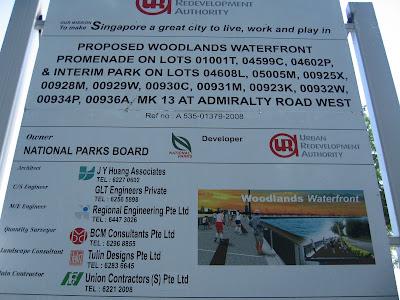
now that the dairy farm nature park has finally been opened to the public, i am looking forward to the completion of another nparks project in the north of singapore - the woodlands waterfront promenade. i enjoy following the progress of the work at such sites. i will go back once in a while (few months) to update myself on the development. this was my second visit since they hoarded up the place.


they had already hoarded up the entire stretch of the proposed promenade, and construction works started a few months back. looks like the old path will be replaced by a boardwalk that will extend over the water of the straits. the skyline of johor bahru will be just a bit nearer and more visible.

work on the vacant land at the end of the promenade had started earlier. there will be picnic areas, fitness corners and playgrounds for children. included is also a nature trail which will link up with the one at admiralty park, located just across the road.

Sunday, September 13, 2009


what used to be here?


in the second photo, bounded by the four lamp-posts was a structure. what was the structure that used to occupy this irregular patch. i do not think it was octagonal in shape (like this).

Monday, September 7, 2009


two dragons at lorong tawas


i have always had the impression that there was only one dragon kiln left on the whole island - the one at thow kwang pottery. today, i discovered another dragon, nestling further inside the track of lorong tawas. it is located at 97l lorong tawas and it is referred to as the jalan bahar clay studios. according to one source, there used to be three dragon kilns in singapore. the defunct one used to be somewhere in the yio chu kang area. it was called the sam mui kwang dragon kiln.


checking on its history, i found out that this dragon kiln was started in 1958 as the guan huat dragon kiln. its dimensions are identitical to the one at thow kwang, that is, 43m long, 2.2m high and 2.5m wide. today, when we visited, the caretaker of the place, switched on the lights in the tunnel for us to get a better idea of how it was like inside the bowel of the dragon.


when renowned singapore potter iskandar jalil was compelled to stop working from home because some neighbour complained that the huge gas tanks installed in his house were a fire hazard, he moved to jbcs (jalan bahar clay studios) to carry on his pottery work. he has since moved back home after some engineers from exxon helped him to modify the gas tanks so that they would meet the requirements for home use.


unlike thow kwang which has on display and for sale a very huge collection of pottery and porcelain wares, the jbcs does not seem to be into sales of finished products.


if you have children, they will definitely prefer thow kwang pottery because there are children's toys and other things that will interest them. however, not all the artifacts and items on sale at thow kwang are their own products. there are also some antique stuff and some creative pieces of art works.


other attractions at thow kwang, where you can spend a whole morning exploring it, include a pond, a tree-house (?) and pottery pieces done by school children.