Showing posts with label BYGONE DAYS. Show all posts

Friday, July 29, 2011


toads never had a chance


when we were growing up in the kampong, we did a lot of cruel things which could have landed us in trouble with the law today and which would definitely incur the wrath of animal lovers. many a 'harmful' animals died in our hands and even not harmful ones like dogs and cats were not spared from our merciless acts.

the dogs in the kampong could hardly finish their mating act in peace. whenever they were joined, we would do everything and anything to put them asunder. we hit them with sticks and hurled stones at them. when this did not work, we got hot water and poured it on them, specifically, onto where the genitals were. cats were luckier, they were not abused in the same violent way but when the mother gave birth, sometimes the kindles were abandoned.

rats caught in cages were either scalded alive or drowned in the drain or by submerging the cage in a pail of water. mice were caught with the mouse-trap where they did not usually have a chance to survive. the grown-ups, especially men, ate new-born mice wrapped in preserved mustard (kiam chye). birds were either injured, maimed or killed by stones propelled from a catapult (the malay name for it is lastik) which is featured in this blogpost.


cockcroaches and lizards, which we rarely see nowadays, were all over the place. cockroaches were crushed or slammed with slippers or whatever we could lay our hands on. a lot of people, including grown-up men, were scared of cockroaches but that did not prevent people from trying to exterminate them. lizards were more difficult to catch but when caught, they were often burnt to death. often only their wriggling tails seemed to survive for sometime.

but i think one of the most abhorred creatures was the toad. we were led to believe that the toad was a poisonous animal, so we learnt to hate it like poison. being ugly did not help the toad at all. whenever one was spotted, it would be savagely attacked with stones or sticks as we wanted to keep our distance from the poison. we were actually scared when the toad puffed up because we feared that it would expel its poison.


incidentally, i did not come across a frog, the edible kind, all the years when i was living in a kampong. the first time i saw a frog in the wild happened only recently, about 5 years ago, at a run-off canal at the macritchie reservoir. would we have attacked a frog if we had seen one?


of course, i did not do all those things that i have mentioned. i can count cockroaches, lizards, rats and toads as having died by my hands.

Monday, July 25, 2011


i admit to peeping in the past


in my blogpost on lovers' haunts and peeping toms i mentioned that those guilty of peeping on love-making couples at places like macritchie reservoir park, fort canning park and other popular spots were mostly old men and teenage boys. in that post, nowhere did i give any indication that i was also a voyeur.

i must confess here that when i was in my teens, i was also into peeping, but only occasionally, and when the opportunities presented themselves. i always did it on my own. as the lighting was not very good, i usually did not get a good look at what i was supposed to see. some of the time i had to rely on my imagination to decide what was actually going on.

although it happened nearly half a century ago, i can still show you where i did my peeping and how it was done.


this was the type of machine where i did my peeping. actually, those machines on which i watched some of the black-and-white images were not so sophiscated; they were improvised home-made machines which made use of the same principle.


the operator of the peep-show machine would come around on his bicycle with the machine strapped onto it. if i remember correctly, we had to pay 5 cents to view a filmlet on some cartoon show. of course, there was the more sleazy kind where you could see some images of scantily clad women or even of a naked woman running around.


this peep show machine shown above is called a mutoscope. in some places, they call it the 'what the butler saw' machine. it is a simple form of motion-picture machine in which a series of views, exhibiting the successive phases of a scene, are printed on paper and mounted around the perphery of a wheel. the rotation of the wheel brings them rapidly into sight one after another, and the blended effect gives a semblance of motion.


this type of machine which could have been found in an arcade was coin-operated but the viewer had to turn the handle continuously to watch the show. in the uk, this machine was called 'what the butler saw' because one of the most viewed shows had this title. the show was about a butler peeping through a key-hole to watch a woman undressing.

Friday, July 22, 2011


towing a car with a rope


in the days when roads were not so congested and tow trucks were not in vogue, it was a normal practice to use a length of rope to tow stalled vehicles. it had to be a thick, sturdy rope, at least 3cm in circumference but not too long, about 2m. of course, there were some who thought incorrectly that the longer rope, the safer. the rope had to be secured to the front of the towed car and the rear of the towing car.

it was a tricky manoeuvre for both drivers - the one in the towing car and the other in the car being towed. they both had to maintain a slow and steady speed. the one in the towed car had to be particularly alert. the back car had to brake almost in tandem with the towing car. when taking a bend, they had to go slower and a bit wider than normal. the front car should never brake suddenly. the driver of the front car also had to check his mirrors constantly.

the towing car should preferably be bigger than the car being towed, at least of a bigger capacity. there should be some indication that a car was being towed, like leaving the hazard lights of the towed car on. for safety reasons, the car lights should be switched on when towing at night.

in those days, you could secure the rope to the frame of the car. in some cars, there was a special tow strap for the purpose. today's cars still come with these metal tow eyes, at the front and rear of the car chassis.

to get into the towing position, you had to back the second vehicle up to the car that was being towed. while in motion, the rope should be kept taut.


there had been incidents when the rope snapped and others when the rope came loose.

in the past, i also remember seeing some people using a tow bar - a long, flat metal piece - which was attached to the cars in the same way as the tow rope.


traffic laws are different in different countries. i understand that in the united states, the towed car should be unoccupied while it is being towed. this means that it will be not be possible to use the rope method.

i wonder if it is still legal to use a rope to tow a car in singapore. i have not seen anyone using this method for a long time.

Wednesday, October 27, 2010


'bengali' jute bed

picture from national archives of s'pore


i was exploring the mandai industrial estate when i caught sight of this bed. the last time i saw this type of bed was more than 35 years ago. in those days when schools still had watchmen, the sikh 'jaga' in the school, where i started my teaching career, had one of these beds. although the material used is different, the frame and structure have not changed much. in the days when such beds were more common, the ropes were made of jute. the bed frame i saw today was fashioned out of nylon ropes.


the owner of this bed told me that during the japanese occupation, the simple jute bed was not exclusive to the sikhs. it was used by people of all races - chinese, malays, indians and others. according to him, the jute bed was cheap and easy to construct. it was even portable and it could be stored away in some corner when it was not in use. i remember we called it 'bengali bed'. the proper name for it is charpoy.

do you use a mattress with this bed? the person told me that he does. however, if he is just resting on it for a while, then he does not need the mattress. in the past, i have not seen anyone placing a mattress on top of the rope frame.

this reminds me of a kind of game we used to play as kids. we would manipulate a length of string, secured at the two ends, to eventually form a 'bengali' bed. this game of sort involved two players. you could not play it alone because it involved transferring the pattern formed by the string from one player to the other.

Saturday, October 9, 2010

people's park market


people's park complex is a 31-storey commercial-cum-residential building on eu tong sen street, within the chinatown area. the shopping centre was completed in 1970 and the residential block in 1973. it was then the largest shopping complex in singapore and it was the first to have an atrium within a shopping centre. the developer was a gan eng seng alumnus called ho kok cheong.

what was here before the complex was built?


photo from national archives of s'pore

the people's park complex was built on a site that started off as an open public park at the foot of pearl's hill. the park later became the people's park market. the hokkiens called it 'chin choo pa sat', the pearl's market. there were outdoor stalls selling textiles, sundry goods and food, much like the former beauty world town at 7th mile upper bukit timah road.

'people's park market used to be singapore's oldest pasar malam (night market) housed in pre-war zinc sheds'....caption for the national archives' photo.


however, the difference was that people's park market was set up and managed by the municipality or the city council. it was more organised and there were concrete pavements around the stalls. beauty world at 7th mile was more like a maze, with stalls, some in attap shacks, set up in a haphazard manner.

the outdoor stalls at people's park market were arranged in rows, just like those in a covered market, but they were packed closer together so the place was rather warm and stuffy. some referrred to it as singapore's version of hong kong's 'ladies street'. it was patronised by people of all races. tourists were also attracted to this market. the day market sold fresh food and vegetables. the night one was more like an open-air restaurant, selling cooked food and drinks. there was always the bargain offers of dresses, textiles and household goods.

both people's park market and beauty world town suffered the same fate - they were destroyed by a big fire. fire gutted the people's park market on 24/25 dec 1966. the loss amounted to a million dollars. in the case of beauty world market, there were about 5 fires, the last one being in 1977.

after the big fire at people's park market, the former stallholders were given places in a temporary shopping centre along the same road.

in my next blog post, i will feature the beauty world market.

Saturday, September 4, 2010


exam results in the 60s


i seem to be harping back to the 60s in my last few postings. in retrospect, the 60s was a very interesting decade not only for me but for singapore as a whole. if you talk to any senior citizen, he or she will recall that particular period with nostalgic fondness because of the many wonderful memories relating to clothing, music, food, social activities and things in general.

my fellow blogger andy young has a blog dedicated to the pop music of the 60s. on the fashion scene, there are many who blog about the clothing in the 60s, one of which is this blogger. as for food, there were the real hawkers and you could get food delivered right to your door. the sellers of nasi lemak, epok epok, tok tok mee, bread, green bean soup and red bean soup peddled their ware from door to door.

another interesting feature of the 60s, which has been discontinued, is the publication of examination results, especially those of the school certificate and the higher school certificate in the straits times. the school certificate is equivalent to today's gce 'o' level and the higher school certificate is the 'a' level.

there would be a few pages devoted to the examination results. if you had made the grade your name would appear under your school name with the passing grade (1, 2 or 3) next to your name. for the higher school certificate results, it was either a 4 or a 5 next to your name. a 4 meant a full certificate. a 5 referred to a partial certificate. to qualify for a full certificate, you needed to have 2 principal level passes and two subsidiary level passes, including a pass in the general paper.

in the earlier part of the 60s, there was no junior college. the first junior college, national junior college, came into being in 1969. in 1965, for example, pre-university education was offered in about 11 schools which included acs, bartley, beatty, chij, gan eng seng, montfort, raffles institution, st andrew's, st joseph's institution, st patrick's school and victoria school.

the results of private candidates were not publicised in the newspapers but those who sat for the examinations under the lembaga gerakan pelajaran dewasa (adult education board) were.

Tuesday, August 31, 2010

tontine

this was on page 8 of the straits times, 28 june 1985
ANOTHER TONTINE 'HEAD' GOES MISSING


i remember my mother subscribing to a tontine initiated by a distant relative who lived in the same kampong. the tontine head was referred to as the 'huay tow'. from what i have learnt, most of the tontine heads in my kampong were women. they would gather a few friends, relatives and neighbours to join the scheme. the number subscribing to a tontine was not fixed; it could range from fewer than 10 to more than 30. it was not impossible for some tontines to have more than a hundred members, considering that quite a number of the tontine heads absconded with a few hundred thousand dollars.

tontine was basically intended as a mutual aid programme. it was a way of securing a substantial sum of money at short notice to meet a contingency or to settle a debt. not all who joined a tontine, however, were desperate for money. some might have more than one share in the same tontine.

the contribution varied from one tontine to another. in the early years, monthly subscription could be as little as $10. that particular tontine my mother joined was $50 per share. bidding was held on a fixed day, usually, once a month. it was not compulsory to turn up for the bidding. the pool of money went to the highest bidder. sometimes when there was no bidder at all, the 'huay tow' would call on qualifying members to ask if he or she would like to put in the minimum bid.

if you had bidden and collected from the pool, then your share would be considered 'sie huay' (dead tontine). subsequently, you would have to pay the full amount of $50 each month until every member had received her share from the pool. in some cases, the 'huay tow' got a cut, like a service charge, from the pool money. if you had not collected from the pool, then your share was considered alive ('wuat huay').

my wife explained to me how it worked. let us say the monthly contribution was $50 and there were 10 members, including the 'huay tow' in the group. for example, member 'ah soh' highest bid was $5. she would get a total of $405. since her bid was $5, the other 9 members needed to pay her only $45 ($50 - $5) each. this gave a total of $405. where a service charge was due to the tontine head, 'ah soh' would end up getting only $380.

usually, the member who took the last pool profited the most. so, those who were not in urgent need for money would not bid high at all. they would just put in a nominal bid each month or not placed any bid at all.

as tontine was quite loosely organised, there could be variation as to how the pool of money was distributed. in some cases, the 'huay tow' was entitled to the first loan. the head could dispense with the service charge, especially if all the members were close friends or relatives.

we often read about the disappearance of tontine heads in the daily newspapers. there was one case where the organiser of a tontine absconded with more than a million dollars. in fact, after organising a few tontines, the 'huay tow' of my mother's tontine group went into hiding in muar, johor, for a few years.
tontine was illegal and it still is.

Sunday, August 29, 2010

home-made pinball machine


looking back at the things that we constructed in the past, i cannot help but marvelled at the enterprising and inventive spirit of the children of those days. if you go to blogger chun see's goodmorningyesterday, you can read about the toy gun that his friend chuck made during his kampong days. i too made and played with such a toy, using the same kind of ammunition - the green unripe fruit of the jamaican cherry tree. the tembusu tree provided the best material for making lastik (catapult) which we used to shoot birds and sometimes, dogs.

besides lastik and toy gun, i remember we also had a modified pinball machine. it was made using rubber bands and iron nails and played with colour marbles on a wooden board. to incline the board, we raised the top by placing a piece of wood, brick or a box under it. where would we have seen a real pinball machine? i guess it must have been at the new world amusement park at kitchener road.

there were two versions of the home-made pinball machine. one had a 'shooter' to propel the marble upwards so that it would eventually drop, hopefully, into one of the winning slots. like the actual pinball macine, we also had some devices that would bounce the marble around. this 'bouncing stick' was constructed using a nail with a rubber band wrapped all around it. there were also some constructed using two nails placed about three centimetres (about 1 inch) apart with two or three rubber bands stringed between the two nails.

another version did not have the 'shooter'. you simply dropped the marble from one of the openings at the top. with the board inclined, the marble would eventually travel to the bottom or end up at one of the winning slots.

so, what was the prize for winning at the game. according to one friend who used to play the home-made machine, it was a small bag of colour glass marbles.

of course, our backyard pinball machine did not come with flashing lights and sounds of bell ringing but it did provide us moments flushed with excitement and joy.

in the earlier years, pinball machines found at arcades were the mechanical type. the electronic ones appeared in the late 70s. malaysia banned pinball machines in arcades, amusement parks and private clubs in 1983. i am not aware of a similar ban in singapore.

Monday, August 9, 2010

'kampong of forgotten souls'

a kampong house in the 50s (from national archives, s'pore)


i just found out that the kampong (kampong chia heng) where i spent nearly 30 years of my life was labelled 'the kampong of forgotten souls' in the 50s. i also found out that the rows of attap houses that we stayed in were constructed without a permit. although it was located 6.4km from the city, there was no proper road, no proper sanitation and no electricity.

a complaint was lodged when three blocks of unauthorised wooden and attap buildings were under construction. the authorities were not able to find out who the 'developer' of the buildings was. by the time, the people who claimed to be owners - 7 women and 5 men - were charged in court, there were already nine blocks and some were already occupied. anyway, there was no court order to demolish the illegal structures. the 12 owners - all chinese - were fined $30 each. it was reported that the 'kongsi' raked in a profit of some $400 000.

in the early days, there was no electricity although there was piped water. there were two public stand pipes serving a population of 1000. when electricity first came to the village, it was in the form of a noisy private generator which was operated for four hours between 7 p.m. and 11 p.m.

in a 1953 government report, 9 congested areas in singapore were listed as potential fire risks and kampong chia heng was one of them. the following year, the villagers were praised by the fire department for helping to prevent a lallang fire from spreading to the houses. actually, i remember there were a few instances when we all pitched in to help put out fire, not just lallang fires but also fires that started in some of the houses.

kampong chia heng also made the news in 1963 when a 62-year old village man was infected by cholera. all the people in the village - babies, children and adults - had to be innoculated against the disease. the man was hospitalised at middleton hospital (orr sai).

in the political scene, i can remember three members of parliament. the first was a hainanese barber, a mr lim, who later defected to the barisan socialis. subsequently, we had mrs devan nair and she was succeeded by mr lawrence sia, a former president of the teachers' union.

i have blogged about my kampong in this earlier post.

Saturday, June 12, 2010

can you get samsu in singapore, today?

photos from national archives of singapore


in the 60s and 70s, i often came across reports on "illicit samsu distillery smashed" or "mash seized in samsu swoop" in the straits times. i had guessed that samsu was some kind of cheap liquor but i did not really know what it was made from. today, if you try to google for 'samsu', you may not get the answer you want.

samsu is distilled from fermented rice mash. samsu was a poor man's drink. it was also used as an ointment and an offering during prayers, mainly by the chinese. pregnant (chinese) women used to bathe with it. like toddy, it was popular with those in the low-income group. however, it was cheaper than toddy and the kick, which was twice as strong, came quickly.

many of the illicit samsu distilleries were hidden in the rural farming areas like tampines, yio chu kang, lim chu kang, upper thomson, upper serangoon and potong pasir. these 'factories' were usually located near some streams or ponds because a lot of water was needed for the production of the samsu.

although there were licensed manufacturers of samsu, illicit samsu was preferred by most drinkers because of the higher alcohol content, around 60%, and, of course, the cheaper price. up to the 70s, there were still illegal dens all over singapore selling samsu. for between 30 and 50 cents, you could get a samsu drink served with titbits.

the authorities, especially the police and customs people, were determined to stamp out the illegal production of samsu because of revenue lost through the non-payment of duties on the liquor and more so, because of the health hazard posed by the consumption as the samsu was usually prepared and distilled under unhygienic conditions.

chun see, my fellow blogger, may be able to provide us with more information on the making of illegal samsu because where he used to live, lorong kinchir, there were some bootleggers.

can you buy samsu legally today? maybe, not in singapore but i have read about school-boys consuming samsu in west malaysia.

Tuesday, May 11, 2010

grasscutting, now and then


this morning, i was at upper seletar reservoir watching some park maintenance workers cutting up a fallen tree with motorised chain saws. it made me think of those days when most of this work was done manually, with either a saw or an axe. today, even with such mechanical cutters, they took quite some time, working in the midday sun, to cut up the huge trunk of the tree.


these days, when cutting grass on the slopes or even on big open fields, most contract grasscutters use a petrol-operated machine, strapped to the back, that comes with disposable plastic bands at the cutting end. if it is a big area that needs to be trimmed, the noisy brigade of foreign worker-grasscutters will move in a formation. surprisingly, the plastic band appears to be cut the grass faster and better than the metal blade that was used in the past.


even though the cutting is done with a plastic band, there is still the likelihood of someone getting hurt if one gets too close to the grass-cutter. from my experience, whenever the grass-cutter notices a pedestrian approaching, he will stop cutting for the moment. also, every one of them carries a board at the back which says ' danger! keep clear!'


so, how was this grass cutting task performed in the past - in the 50s and the 60s?

i remember the grasscutters used a scythe or an implement like those shown in the picture below. the grasscutters would have a coarse sharpening stone and some water with him and every now and then, he would stop to sharpen the blade. in those days, the number of grasscutters in a team seldom exceeded four. there were not so many grasscutters then.


you really had to keep your distance from the grass-cutter when he was doing the cutting because the blade was a rectangular metal plate. while most grass-cutters today are foreign workers, those in the past were mostly locals.

Saturday, April 3, 2010

04, 08, 18, 21, 24 and 369


scene of a gang fight - picture from national archive of s'pore


do these numbers make any sense to you? no, they cannot be toto numbers because the last one has 3 digits. there might have been other numbers but these were the ones i can recall. if you grew up during the 50s and 60s, you would have known someone who secretly or openly declared that he belonged to one of these numbered gangs. among my schoolmates and kampong kids were some who claimed allegiance to one of these secret societies.

each gang had its own so-called trade-marks. hand gestures and tattoos were two clear ways of identification. i was told that those who belonged to the 24 gang had two birds, i think they were either swallows or swifts, tattooed on one of their shoulders. i have heard of the butterfly gang - a woman gang in which members had the tattoo of a butterfly on their body.

gangland clashes were common in the 50s and 60s, even right up to the 70s. in the late 50s or early 60s, during the school holidays, i used to stay over with some relatives at dunlop street, a hotbed of gangland activities. a number of times, in the middle of the night, the silence would be broken by the sounds of bottles being smashed, shouting and heavy running footsteps. i was told not to venture out. these clashes, in which parangs, iron pipes and broken bottles were used, usually ended as quickly as they had started.

secret society members seemed to have scant respect for the living as well as the dead. in those dark days, fights at funerals and wakes were not uncommon.

my former neighbour in the kampong, who attended the same primary school as i, started young. at primary 3, he was already relieving me of my pocket money - ten cents each day. this went on for sometime and i cannot remember how and when it finally ended. extortion was one of the ways the gangsters derived some form of income. the other was collecting protection money from shops, hawkers, food stalls, bars and gambling dens.

this particular neighbour of mine ended up as a big-time gangster. i learnt that he was involved in a murder for which he was detained 'at the president's pleasure'.

some gangsters 'retired' after they had set up their own families but they continued to work in the background. they could still be called upon to help negotiate at 'settlement talks' but they would try to keep their hands clean by not getting involved in fights or clashes that might arise out of any failed talk.

not all gangsters were pimps or people who engaged in shady or underground activities. some held respectable jobs. these people would keep a low profile but their trade-mark - the tattoo - that they wore on their bodies might be a giveaway of their past connections.

Tuesday, March 30, 2010


the potato sack race


how many still remember the gunny sack race you took part in on sports day when you were in primary school? the sack race used to be something universal: primary or junior school pupils all over the world have had the experience of the wrestling with the rough sack as they tried to haul it across the field as quickly as possible to the finish line. in singapore, it looks like not many primary schools have retained this fun event as part of their sports day programme.

i remember in our primary school days, we referred to it as the potato sack race. why potato sack? it is because the jute bag's original use was to pack agricultural produce such as potatoes, corn, coffee beans and grains like wheat and rice.


some pupils disliked the feel of the coarse jute rubbing against their body as they struggled with the sack to maintain their speed and balance. it got hilarious when some participants tripped and stumbled. this particular event is a test of speed, strength and flexibility. you were supposed to get into the sack, gripped the top tightly and jumped or hopped all the way to the finish line. if you walked or ran, you might finish but you would be unlikely to win the race.

do you know that the sack race was an olympic event in the 1904 olympics held at st louis?

what about these other events held on the school field twenty, thirty or forty years ago? do you remember them? the egg and spoon race? balancing the bean-bag on the head race? crawling through cane hoops race? throwing objects into a wicker waste-paper basket? balancing the quoit on the head race?

Tuesday, March 23, 2010

bath time in the kampong

picture from national archive of s'pore
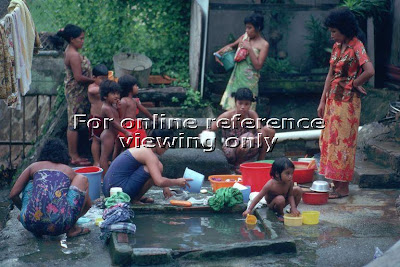
bathing in the kampong generally meant bathing with cold water, no matter what time of the day. we did not have this option of warm and cold waters, that is available (nowadays) by merely adjusting a knob. nevertheless, on warm days, when the metal pipes got heated up, we did get warm water gushing out of the tap, provided we bathed with the water right off the tap. during the rare times when we had to bathe with warm water - like when we were feeling under the weather - we had to boil a kettle of water and mix it with water from the tap or water from the container. on such an occasion, we would use a metal or plastic tub to hold the lukewarm water.


most households would have a huge ceramic or clay water container in the bathroom. this did not serve as a bath tub although it could have been mistakenly used as one by some unknowing guests, especially those from the then more developed countries.


the water collected in this pottery container was most of the time cooler than the water from the tap. in fact, it was cold. it was so cold that, i remember, my father had to thump his chest a few times before he splashed water on himself.

with this common pool of water, sometimes two or three children could have their bath at the same time. they just needed more scoops or they shared the scoop.


those days, bath foam or soap in a liquid form was unheard of. the fairer sex would use the fragrant 'lux' or 'palmolive' soap while most men would use any ordinary soap. some even used the 'axe brand' laundry soap.


picture from national archive of s'pore


there was, however, a choice of where you would like to take your bath. you could do it in the out-house or the bathoom - usually located in the kitchen area - where you enjoyed some privacy or you could compromise your privacy and take your bath at the public standpipe or at the communal spring. there was no public well in our kampong although a few households had their own wells.

Friday, March 12, 2010

the hen that flew the coop


i was browsing at queen victoria market in melbourne, when i came across cages of chicks, ducklings, ducks, quails and hens. it makes me wonder if australians are immune to bird flu. in singapore, a quail farm at lim chu kang lane 6, which was very popular with school-children and other visitors, had to quickly close its door, or rather its gate, when the bird flu hit. these days, in singapore, you do not get to see any live poultry at wet markets or any other market.

poultry reminds me of my kampong days. we used to keep free ranging - as the australians call them - or kampong chickens and ducks, just outside the compound of our house. my mother would go to the vicinity of the now defunct kallang gaswork to buy the baby chicks and ducklings. to protect the young poultry and to keep them warm, an oil lamp would be kept burning in the cage throughout the night.


those days, the baby chicks and ducks cost a few cents each. i do not recall the ducklings being noisy but the chicks would be chirping away throughout the day and intermittently, at night. the chicks and ducklings were reared to be sacrificed, when they became adults, to the gods on the many festivities that are celebrated throughout the year.

however, some were spared. the egg-laying hens and ducks did not end up on the altar table. i recall having to go around collecting the eggs laid by the hens and ducks that we kept. the newly-laid eggs were warm to the touch. the hens' eggs were smaller than the ducks'. sometimes, the birds strayed to the neighbours' compound to lay their eggs. the taking away the egg became atricky and sensitive issue.

once, i remember, one of the hens flew to the top of our zinc-roofed house. we tried to coax it down but to no avail. finally, i had to climb to the top of the roof, via the guava tree, to shoo it down. it was also something of a realisation for me..that chicken can fly and fly quite high.

some chickens were destined for a higher purpose. these were the cockerels that were castrated. the caponised rooster would grow very big but when the time came, they would be offered to the heavenly god (tii kong) on the 9th day of the lunar new year.

today, in singapore, if you want to see chickens, you will have to visit some of the big commercial poultry farms at lim chu kang, sungei tengah or jalan murai. ever since the bird flu scare, the authorities have banned all forms of small-scale rearing of poultry, so you do not see chickens or ducks in somebody's backyard, not even in rural pulau ubin.

Thursday, February 25, 2010

pranks of kampong kids


thinking back about the pranks we played on one another when we were kids in the kampong, i think it reveals a streak in meanness in each one of us. or we put it to our being too young to consider the consequences of our actions and the pyschological harm done to our victims.

i have blogged about how we would rub the rubber seed continuously on some hard surface before pressing it against the flesh of our friends to give them a scorching time.

there were other acts which we carried out to embarrass our friends or to cause discomfort or unpleasantness to them.


one of the pranks that we would play was pulling down the loose pants of our unsuspecting friend, especially in the open and often in the presence of girls. you have to remember, in those days we went about - like what the hawaiians say - hanging loose: we did not wear underwears.
it was not like in this video clip where the men and woman all had undercovers.


another mean act of ours, which would cause discomfort to our victims, was to get the ripe red fruit of the macarthur's palm and rub it against the skin of our victims. when the sap of this fruit, a favourite with birds, comes into contact with the skin, it will cause one to feel an itching sensation. our poor friend would quickly look for water to seek relief to wash away the offending sap.


another trick which we played on newbies is using the stalk of the lallang flower. you can only play this once on some uninitiated ones. once they have tasted a mouthful of it, they will not fall for it again. the flower of the lallang is rather cottony. we would tell our would-be victim that the stalk was sweet. the moment, the victim put his lips to the stalk, we would pull it across and he would end up with a mouthful of the cottony stuff.

in this high tech age, children no longer have any use for things found in the natural environment.

Saturday, January 9, 2010

ink-stone and ink-stick


sometimes our memories of the past are triggered by places we visit or by things we see. they can also be triggered by things you come across in your reading. i was reading another book by adeline yen mah - author of falling leaves - in which she mentioned chinese calligraphy and the use of ink-stone and ink-stick.

this transported me back to those days when i had neighbours who attended chinese medium schools. in those days, chinese calligraphy was part of the curriculum, much unlike today, when it has become a co-curricular activity or part of something designated as an enrichment programme in some schools.

i remember the ink-stone was rectangular and had a small reservoir for water. to produce the ink for writing, you dipped the ink-stick in the water and ground or rubbed it, in a circular motion, on the ink-stone or ink-slab. the 'mau pi' (hair brush) had a handle made from bamboo and the brush was made from some animal hair, usually sheep hair.

my immediate neighbour had to write a few pages - i cannot remember how many - each school day. i would volunteer to help him write. you had to hold the brush straight and upright and your palm should not come into contact with the writing paper. i quite enjoyed the exercise because i treated i as a form of art, which it is.

according to my friend nah, who attended both chinese and english schools, at around that time, there was already chinese calligraphy ink that came in a bottle. the calligraphy writing book was double the size of the normal exercise book. the outline of the chinese characters were pre-printed and all you had to do was to follow the lines in the order stated.

Thursday, December 31, 2009


yesteryears' playgrounds

picture from national archive of singapore


sometimes when you want to know or remember how things were like in singapore in the 50s, 60s or even the 70s, it can be done by visiting one of our own off-shore islands like pulau ubin or by visiting one of our neighbouring countries. when i visit places like sungei rengit in johor or seniawan outside kuching, i will describe to my buddies that 'it is just like s'pore in the 60s'.


i was in kuching recently when i saw these pieces of equipment at a playground, then memories of playgrounds where i had played and where i used to take my children to came flooding back. even up to the 80s, the old type of swings and see-saws were still around. i remember the see-saws and swings at farrer park and at dhoby ghaut, just across from the rendevous restaurant.


at some playgounds, the chains attached to the swings were quite long which meant you could swing frighteningly high. these days, you find modified swings at some parks and playgrounds and they do not go as high as the height has been much reduced. are today's children less adventurous or are we more safety conscious these days?

to get the initial momentum on the swing, some of us stood on the seating board of the swing, bent our knees and straightened them and did this repeatedly to get it going. others needed help from some 'pusher'. yet others could get into the swing of things by just flexing their legs while seated on the board.


in both the primary schools where i studied, we had a monkey-bars in the school-field. it was a popular spot with the boys during recess. girls were rarely seen playing at or on the monkey-bars. we would swing from one end to the other. those who were new to it usually ended up with blisters on their palms to show to their parents and friends.


the present day's playground is so much more colourful and attractive and safety is a paramount consideration in the design and built of these facilities. slides, see-saws and swings are still around but they are not as accident prone as those in the early days. they have even incorporated exercise stations, meant for adults, and very popular with the elderly, at some playgrounds.

Saturday, December 26, 2009

oh peh som


'oh peh som' is a method we used as children when we had to decide who should be eliminated or which team one should be allocated to. 'oh peh som' is not a traditional game but rather an efficient traditional way of picking the members for two teams. in fact, it can be tweaked to pick members for more than two teams.

my friend dick (the wise old owl) had asked me sometime back to blog about it but i did not get around to doing it until now. what finally prompted me to do it was when i saw four boys using this method to decide the pairs to play each other in badminton. but, they have a different name for this way. they call it 'black or white'.

in 'oh peh som', the palm and the back of the hand come into play. participants begin by placing one hand - usually the right hand - behind their back. they will stand in a circle or a semi-circle. anyone of them or all of them can shout out 'oh peh som'. at 'som', they have to bring the hidden hand to the front showing either the palm or the back of the hand.

say, like in this case of the four badminton players, two of them display their palms and the other two display the backs, the two 'palms' form one team and the other team members will comprise the two 'backs'. if one shows palm and the other three show back or vice versa, then it goes into another round of 'oh peh som'. the same thing happens when all four end up showing the same side of the hand. it goes on until it is two palms an two backs of the hand are shown.

'oh peh som' can also be used to decide on something you, as a group, want to do. for example, if you cannot decide on whether to go swimming at farrer park swimming pool or mt emily swimming pool, you can always 'oh peh som' to pick the venue for your swim. it is not actually a majority decision; it is more like the luck of the draw. i do not ever remembering any quarrel over a decision made in this way.

here is one overseas singaporean who still remembers oh ah, peh ah, som.

Tuesday, August 11, 2009

starching clothes and pre-uhu glue days


"Then to make the starch, pour hot water on some white powder...." peter made this comment in my posting on laundry blue.


when we were in primary school, during our art and craft lessons, the glue we used usually came in a tube like a small tube of tooth-paste or a small bottle-like container. back at home when we needed to do any sticking or glueing, we would make use of the starch that our mother used for starching clothes.

how do you prepare this home-made glue? those days, my mother used tapioca flour - peter referred to this as some white powder - to make this starchy substance. you can use any vegetable flour. for the picture in this blog, i used some left-over potato flour.

first, you add some tap water to the flour and stir it until it becomes a thick, milky solution. then you add hot water to it, a little at a time, and continue to stir very hard and fast. the opaque solution will gradually become clear. when the paste becomes transparent (as in the top picture), you stop adding hot water.

the paste, if it is going to be used for starching clothes, should not be lumpy. when you want to starch the clothes, you scoop a handful of the starchy paste and dissolve it in a pail of water. then you rinse the clothes in the pail of starchy water. the clothes, when they are dry, will become stiff and this makes ironing them easier.


nowadays, the fabric starch comes in the form of an aerosol spray can. it has brightener to give your clothes that smart, crisp look. it is supposed to help remove creases and wrinkles on your clothes. however, it cannot be used on silk and other delicate fabrics.


for glueing purpose, if you want the 'glue' to be thicker, then you do not need to add so much hot water. the paste will be lumpy but it will stick better. if you want to keep the glue for sometime, then, instead of using just hot water, add some vinegar to the water.


today, hardly anyone makes use of the home-made starch. you can get glue which comes in handy containers or in the form of a stick.