Tuesday, May 11, 2010

grasscutting, now and then


this morning, i was at upper seletar reservoir watching some park maintenance workers cutting up a fallen tree with motorised chain saws. it made me think of those days when most of this work was done manually, with either a saw or an axe. today, even with such mechanical cutters, they took quite some time, working in the midday sun, to cut up the huge trunk of the tree.


these days, when cutting grass on the slopes or even on big open fields, most contract grasscutters use a petrol-operated machine, strapped to the back, that comes with disposable plastic bands at the cutting end. if it is a big area that needs to be trimmed, the noisy brigade of foreign worker-grasscutters will move in a formation. surprisingly, the plastic band appears to be cut the grass faster and better than the metal blade that was used in the past.


even though the cutting is done with a plastic band, there is still the likelihood of someone getting hurt if one gets too close to the grass-cutter. from my experience, whenever the grass-cutter notices a pedestrian approaching, he will stop cutting for the moment. also, every one of them carries a board at the back which says ' danger! keep clear!'


so, how was this grass cutting task performed in the past - in the 50s and the 60s?

i remember the grasscutters used a scythe or an implement like those shown in the picture below. the grasscutters would have a coarse sharpening stone and some water with him and every now and then, he would stop to sharpen the blade. in those days, the number of grasscutters in a team seldom exceeded four. there were not so many grasscutters then.


you really had to keep your distance from the grass-cutter when he was doing the cutting because the blade was a rectangular metal plate. while most grass-cutters today are foreign workers, those in the past were mostly locals.

Friday, May 7, 2010

bronze elephant at old parliament house


since the shift to the new building in october 1999, the old parliament house has been converted into an arts house. the old parliament house was built as the residence of john argyle maxwell, a merchant whose base was in java. it was bought by the government to be used as the court house. the two-storey house was completed in 1827 but maxwell did not live in the house at all. instead he rented it to the goverment.

the bronze elephant statue, that still stands in front of the stately building, was presented to the singapore government by king chulalongkorn of siam (thailand) after his visit to singapore in march 1871.

king chulalongkorn (rama v) was the first siamese king ever to leave his country to travel overseas and he chose singapore as the first country to visit.

the statue was originally placed in front of the victoria memorial hall where the statue of sir stamford raffles now stands. it was moved to its present site in the old parliament house in 1919 when singapore celebrated the centenary of its founding.

it is the only monument with inscriptions in english, jawi, chinese and thai. if you cross over to queen elizabeth walk and look at lim boh seng's memorial, there are also inscriptions in four languages but the thai has been replaced by tamil.

Wednesday, May 5, 2010

ferns are among the easiest plants to identify


when i go for my walks at nature parks and forest reserves, i like to get acquainted with the flora and fauna. i have learned to appreciate the rich diversity of flora and fauna in our urban and rural gardens.

after having tasted the crunchy wild ferns (midin) in kuching, i am inclined to pay more attention to ferns these days when i go for my nature walks. i have come across a species which is similar to the 'midin' in sarawak.

most of the time after finding out the name of a certain plant, i tend to forget its name after a lapse of time. however, with ferns, i do not have this problem because the shape or outline of a fern usually gives a clue to its name. below are four common ferns found in our parks and reserves.

the giant sword ferns grows easily and so they can become quite invasive. i have seen them being grown in pots. they can even withstand strong sunlight. the name comes from its arching and trailing green fronds which resemble a broad sword. there is a whole row of giant sword ferns near the wallace education centre at dairy farm nature park.


the leaves of the staghorn fern are antler-like in appearance. staghorns are epiphytes - they 'grow on others'. however, they are not parasites as they do not draw any nutrition from their hosts. they are commonly found on trunks of trees. kent ridge park is one place where you can see lots of staghorn ferns.


tree ferns refer to any fern that grows with a trunk elevating the fronds above the ground level. i remember the huge ones found in fraser's hills in west malaysia and in the dandenong mountains in melbourne. tree ferns are quite common in our natural environment. i see quite a few along the trails at bukit batok nature park.


this is the most common fern in singapore. you do not have to go to nature parks or forest reserves to see the bird's nest fern. the tongue-shaped fronds of the bird's nest fern are borne from a central, funnel-shaped rosette of fuzzy, brown wool where the emerging fronds resemble bird's eggs, giving the plants its common name.


at the botanic gardens, there is a small section designated as the fernery. i had expected to see a greater variety of ferns here but was disappointed to find only a few species at the fernery.

Monday, May 3, 2010

missing building quiz


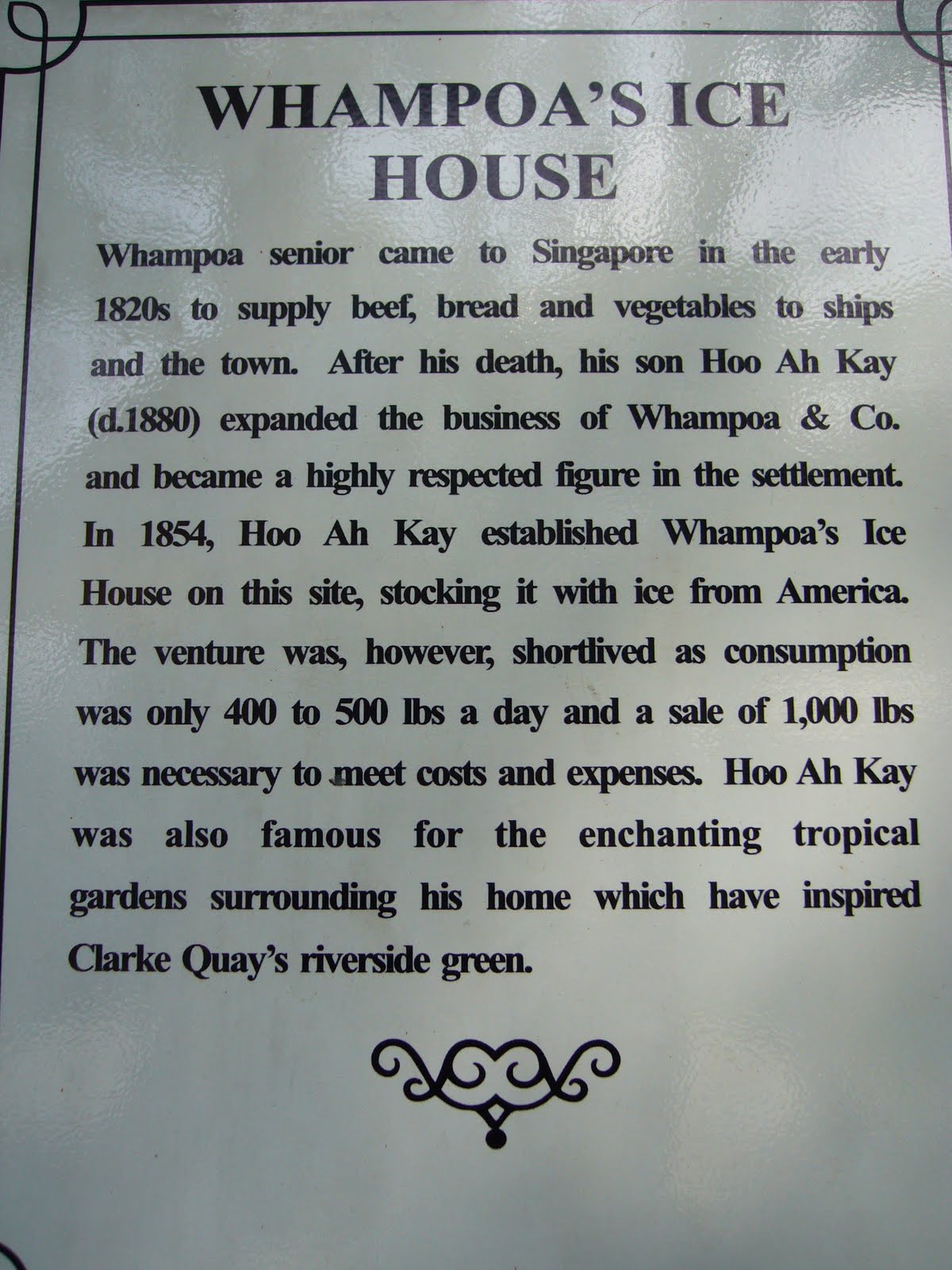
today, we went looking for the whampoa's ice house. we found it but learnt that it was not the original - it was just a replica.

whampoa's ice house was opened in 1854. it was singapore's first ice house that sold imported ice packed in sawdust from the frozen winter lakes of new england in the united states of america. at that time, refrigeration was not in existence.

as a result of an overestimation in the demand for ice, the business venture between whampoa and gilert angus failed and the building was sold to a bank. tan kah kee's rubber company, kiam aik, occupied the building in 1904. the ice house was demolished in 1981.

what you see today is a relica of the ice house built near the original site.


quiz question: where is this building which carries the name 'whampoa ice house'?


the ice house reminds me of 'kek sng kiao' - the hokkien name for sungei road. the name was made in reference to the s'pore ice works which used to exist in that area, at the junction of sungei road and weld road. i remember the location because i used to eat my sungei road laksa from the push-cart stall stationed outside the ice factory.

the first ice-making plant in singapore was located in the sungei road area. it was built in 1930. it was popular as a pioneer establishment that brought refrigeration and airconditioning to singapore. in later years, it was owned by s'pore cold storage and there was also a change of name to 'new singapore ice works'.

Saturday, May 1, 2010

red and green eyes twakows


on friday morning, we went to trace a section of the singapore river. we started from new bridge road and walked westwards until we came to the former jiak kim warehouses, now a favourite haunt of youngsters, going by the name zouk. seeing how nondescript the place looked in the day, i wonder how it could manage to draw such crowds, especially on wednesdays - mambo nights.


we came across a number of bridges spanning the river, some of them known to us, while some we were getting to know for the first time. one of the first bridges was ord bridge. then, there were clemenceau bridge, robertson bridge, pulau saigon bridge and the most colourful of all, alkaff bridge. i remember a pulau saigon circus from the past but not the bridge.


the bumboat, lighter or twakow which was passing under the bridge brought us back to the days when this vessel was used to transport goods from the inner or outer roads to the quay. today, these boats have been refitted to take tourists on a river cruise. some of these boats appear to be air-conditioned.


back home, i was reading this informative brochure published by the national heritage board, when i came across something interesting about the lighters that used to ply the singapore river.


as the singapore river was too shallow for ships to sail through, small boats known as lighters were used to fery goods between the ships docked at the harbour and the quay. the lighter trade was initially dominated by the chuliahs (indian muslims) and their large wooden crafts known as tongkangs for the larger part of the 19th century. chinese boatmen, mostly teochew and hokkien, started displacing the chuliahs at the beginning of the 20th century with their smaller and faster boats known as twakows. despite concerns over the seaworthiness of the lighter twakows, the chinese lightermen and their twakows became a common sight on the river until the last lighter was relocated in 1983 because of the river clean-up project. the twakows, with its distinctive 'eyes' painted at the bow (red for teochew-owned twakows and green for hokkien-owned twakows) can still be found on the river today performing a different role of ferrying passengers instead of cargo.


(from tides of change, the singapore river trail, published by s'pore heritage board)


if you look at the bows of the boats, it is not the eyes that were painted a different colour. in fact, the eyes in both the teochew and hokkien boats are/were black; it is the background that has the distinguishing colour - red for teochew and green for hokkien. looking at both past and present photos, it will appear that the number of hokkien boat owners outnumber the teochew.