Saturday, August 15, 2009

danish seamen's church
(golden bell mansion)


today, we went to locate and explore the danish seamen's church at 10 pender road, mount faber. it is a small church - with a sunday congregation of about 40 worshippers - catering to the small community of danes in singapore. we were told that there are about 1500 people of danish nationality residing in singapore.


there are at least three bells in the compound of this building. wonder if these have anything to do with its association with seamen. the smallest yellow box in singapore is also found inside in the compound of the building. on the day of our visit, there were many prams within the compound. on thursday mornings, they conduct a playgroup for small chidren in one of the rooms in the main building. maybe, the yellow box is meant to ensure that the prams do not block the passageway.


the pastor lives in room upstairs, i suppose, it is just below the dome, and the other two live downstairs in an adjacent building. this blog mentioned that the chinese revolutionary leader dr sun yat sen stayed one night in this building. some of his family members were believed to have stayed in the same mansion, though not at the same time as dr sun.


the dome resembling a buddhist stupa was built in 1909 for straits chinese tan boon liat. the house was sold in 1934 after owner's death in shanghai.

Thursday, August 13, 2009

push start a stalled car


i watched three persons attempting to push start a stalled car along the main road. they did not manage to get very far as their effort proved futile. i was wondering if it was due to lack of trying or lack of technique or was it because the battery was totally drained. nowadays, with most of the cars on our roads having automatic transmission, it is getting rarer and rarer to see people getting into this kind of act.

one should not try to push start a car alone. you should have one person in the driver's seat and one or more pushing. if the car is parked on an upslope, you definitely need more manpower to push it.

for it to be effective, you have to first turn off all accessories that will drain whatever little power is left in the battery, like the radio, lights, air-conditioner, wipers, etc.

turn the key to the 'on' position. depress the clutch pedal and engage 2nd gear. although it works on 1st gear, i usually put the transmission in 2nd gear. keep the clutch depressed.

next, release the handbrake and the foot brake.

the persons need to get the car rolling as fast as it can, so it is best if there is an incline or a downhill. the one in the driver's seat has to simultaneously, release the clutch and step on the accelerator the moment the car has gathered sufficient momentum. once the engine comes to life, he has to keep feeding the petrol to keep the engine running. a word of caution though: he must not accelerate too fast, otherwise the helpers (pushers) may end up with their faces flat on the road.

can you push start an automatic car?

Tuesday, August 11, 2009

starching clothes and pre-uhu glue days


"Then to make the starch, pour hot water on some white powder...." peter made this comment in my posting on laundry blue.


when we were in primary school, during our art and craft lessons, the glue we used usually came in a tube like a small tube of tooth-paste or a small bottle-like container. back at home when we needed to do any sticking or glueing, we would make use of the starch that our mother used for starching clothes.

how do you prepare this home-made glue? those days, my mother used tapioca flour - peter referred to this as some white powder - to make this starchy substance. you can use any vegetable flour. for the picture in this blog, i used some left-over potato flour.

first, you add some tap water to the flour and stir it until it becomes a thick, milky solution. then you add hot water to it, a little at a time, and continue to stir very hard and fast. the opaque solution will gradually become clear. when the paste becomes transparent (as in the top picture), you stop adding hot water.

the paste, if it is going to be used for starching clothes, should not be lumpy. when you want to starch the clothes, you scoop a handful of the starchy paste and dissolve it in a pail of water. then you rinse the clothes in the pail of starchy water. the clothes, when they are dry, will become stiff and this makes ironing them easier.


nowadays, the fabric starch comes in the form of an aerosol spray can. it has brightener to give your clothes that smart, crisp look. it is supposed to help remove creases and wrinkles on your clothes. however, it cannot be used on silk and other delicate fabrics.


for glueing purpose, if you want the 'glue' to be thicker, then you do not need to add so much hot water. the paste will be lumpy but it will stick better. if you want to keep the glue for sometime, then, instead of using just hot water, add some vinegar to the water.


today, hardly anyone makes use of the home-made starch. you can get glue which comes in handy containers or in the form of a stick.

Monday, August 10, 2009

gastronomic adventure in kuching


new parliament building in kuching

at the start of the long weekend, on friday, we took a one-hour-twenty-minute-flight to kuching in sarawak, east malaysia. we returned to singapore on sunday, just when the national day parade was about to begin and definitely in time for the 8.22 pledge.

it was meant to be a social visit but it turned out to be more like a gastronomic adventure even though i am not that adventurous when it comes to eating.

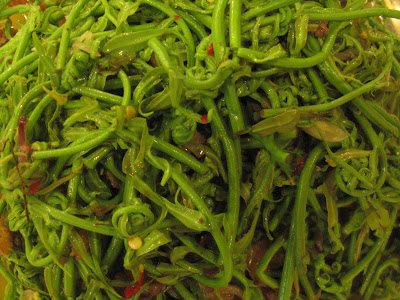
we tried at least four unique and authentic sarawak dishes. first was the wild ferns cooked in garlic and shallots. sometimes, sambal belachan is used to cook the ferns. the ferns are apparently not that wild because, according to one of our hosts, they can be found growing by the road side. we finished the whole plate of crunchy ferns in double quick time. i think the locals call this dish midin.


the second dish was the bamboo chicken (pansoh manuk). chunks of chicken stuffed into a bamboo and cooked with herbs, one variation of which, uses kacang ma. another variation uses tapioca leaves, lemongrass and mushrooms. (kacang ma is a herb promoted by the sarawak state agriculture and food industry. this herb belongs to the mint family. it is believed to have originated in china and brought to sarawak by the hakkas.)


i also tried the sarawak version of laksa. it reminds me of our prawn noodles (hae mee). the authentic sarawak laksa uses fresh rice vermicelli. the soup is rich in 'sanatan' and spices. the toppings include prawns, chicken and thinly-sliced omelette.


of course, you cannot claim to have tried authentic sarawak dishes if you have not eaten the kolok mee - of which there are many imitations in singapore these days. in kuching, you can have kolok mee at any time of the day - for breakfast, lunch or dinner. having not eaten the kolok mee in singapore, i could not make a comparison; i was told that it tasted so much better than those sold in singapore.

Friday, August 7, 2009

chwee kang beo (shui jiang miao)


taking up my suggestion, my monday and thursday walking kakis went with me on a visit to the kolam ayer basin. during my previous visits to that area, i had admired the taoist temple from outside and did not step insideat all. this time we decided to take a look inside as i wanted to see the relica of a ming boat i had read about.


while we were waiting tentatively outside, a lady caretaker proudly pointed out to us that there was a board, put up by the national heritage board, on the other side which has a bit of history of the temple.


located at the kallang river near the upper stretch of boon keng road, chwee kang beo (in hokkien) or shui jiang miao (in mandarin) has been sited here for more than 45 years.

the main deity of the temple is tua pek kong (grand old man) who is considered to be the guardian saint of overseas chinese in south-east asia. another equally important deity is cheng huang (city god) who has been associated with the temple for more than 40 years. other temple deities include the stone lion city god, the horse general and the tiger god.

the area was once known as kampong soo poo. more people settled into the kampong after the japanese occupation. human bones were once washed up at the site of today's temple. in order to alleviate the bad omen and to seek protection from deities, the villagers erected a simple shrine.

over time, the shrine evolved into an attap-roofed temple. it gained a tarred rof and stilts in 1961 as it would flood during high tides and heavy rain. since then it has attracted many devotees from the then kallang gasworks nearby. in 1991, the temple managed to establish ownership of the site with the help of two malay members of parliament, and with the support of devotees and residents, carry out the latest rebuilt which was completed in 1993.

the temple used to be sited next to the former jin mu chang boat factory and whenever there was a new boat to be launched, a ceremony would be held at the temple to bless the new boat. the ceremony was last held in 1970.

this is extracted from the heritage website:

there is a boat which is unique to this temple by the river. the boat is built of teak and is a scaled replica of a mng dynasty era vessel, complete with a keel, canvas sails, rigging and even miniature ladders in the cargo hold. it was built by a devotee who once used to build and repair boats in the area. i took him two months to complete the miniature boat.