Friday, May 1, 2009

workers' dormitories at murai

not all foreign workers are like housed in cramped, unhygienic, poorly ventilated conditions like those reported sometime ago in the tagore area. today, while exploring the farming area at murai, after the lim chu kang cemeteries, i came upon this complex which looked like new factories.


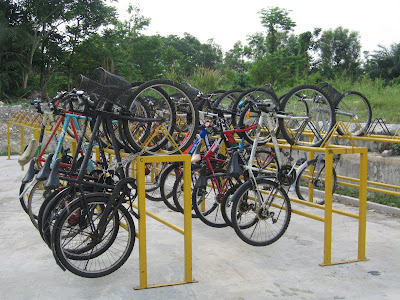
there is a specially-built bicycle rack, in an area the size of a car-park, for the workers to park their bicycles. the workers definitely need a bicycle if they want to get to the nearest place to meet the local people - that would be at jurong west, where there is a sheng siong outlet at jalan bahar.


the dormitories have their own gymnasium, reading rooms, outdoor games courts, mini-mart, canteen and even a barber shop.

the dormitories at murai will eventually house about 12 000 workers of all nationalities. the place is managed by the building and construction authority (bca).

aksed about how they feel about living so close to cemeteries, the manager of the dormitories said: 'The workers don't care what is outside as long as the living quarters are comfortable and transportation to work is available.'

Thursday, April 30, 2009

what are at 2, 4, 6 nassim road?


at no:6 is a spa boutique. spaboutique ~ the city resort spa @ nassim is located just a stone's throw away from orchard road at 6 nassim road. step from the busy metropolitan atmosphere of the city into sprawling grounds surrounded by nature. soak in the nature calls and the ambience of an early 20th century colonial-style bungalow, as you relax and refresh under the personalized care of our experienced therapists.


at no:4 is pecc secretariat. pecc stands for pacific economic cooperation council. it is a non-governmental institution. the building is vacant as it is undergoing renovation or as they put it, rectification.


at no:2 is siia house. siia stands for singapore institute of international affairs. unifem stands for united nations development fund for women. aidha is a not-for-profit organization dedicated to ‘enriching lives through financial education.’ inspired by unifem's national committee, singapore, aidha serves women migrant workers.


i went looking for no:3 nassim road and ended up with 2, 4 an 6 nassim road.

what was the tourist attraction i was looking for which used to be at no: 3 nassim road?

what is at this address - no:3 nassim road - today?

Wednesday, April 29, 2009

sucking the nectar from the ixora


children today do not seem to have the same adventurous spirit that we had when we were young. we tasted all types of fruit, including some found growing in the wild. (incidentally, i have seen the ixora plant growing in a forest.) we climbed trees to get at the fruit. when i was young, i climbed coconut, rambutan, guava and mango (kway nee) trees as well as some other trees which do not yield fruit.

we ate fruits which today's generation of children do not and would not touch. we ate the fruit of the passion flower, the 'buah cherry' and the jambu mawar. the 'buah cherry' fruit was not only eaten, it was also used as ammunition for our home-made gun. we would use the hard green unripe 'buah cherry' as bullets to attack our 'enemies' in a friendly war.

although we did not have the benefit of any jungle survival course, we could very well have survived on the things found around us like some of the fruits i have mentioned. as kampong kids, we knew that tapioca has underground roots which can be eaten. i remember how we would steathily unearth the sweet potatoes from a plot outside one of those houses at chancery lane. we took the sweet potatoes home and threw them into the lower chamber of the charcoal/firewood stove. just like in a barbeque, the heat would eventually cook it.

the other day, as i drove past two mata kuching trees along rifle range road, my friend told me how they used to get the fruit down from the mata kuching tree near his house. they would tie two lengths of rope to the end of a short plank or stick. they would then hurl the plank or stick at the tree, aiming at some bunches of the fruit. when it got caught on the tree, they would pull the two ends of the rope and the mata kuching fruits would drop to the ground. if they did not have ropes, they would just hurl ('punggol') the stick at the fruits.

so, what about the ixora? well, we used to suck the nectar from the base of the individual flowers. it was one way to quench our thirst and at the same time provided us energy because it was sweet. the small flower has a tube. inside this tube is a filament. we would remove the filament and suck at the base of this tube to get the sweet juice (nectar?).

many of my contemporaries have also tasted the nectar of the ixora. some would remove the whole bunch and suck at them. some tell me that hibiscus flowers - which i have never tried - also provide sweet nectar.

it seems children in other countries have also discovered the nectar in this flower. when i read the comments in one blog posting, i realise that it is almost like an universal practice. however, nowadays with insecticide or pesticide being sprayed on the plants and flowers, it may be hazardous to one's health to suck at the base of the flower.

Tuesday, April 28, 2009

tell me why-declan galbraith

a meaningful song.

the moringa tree - the drumstick tree


when it comes to eating and people mention drumsticks, they are usually referring to the thighs of the chicken but when my sri lankan friend mentions drumsticks, he usually looks at a particular tree. today, as we were walking towards casuarina curry restaurant, we walked past two of these trees. i decided to take some pictures and to find out more about the drumstick tree.

it seems the moringa tree is a very useful tree and nearly all parts of it can be eaten. the leaves, the pods and the roots are eaten; the flowers are loved by bees; and the seeds (from the mature pods) are powdered and used to purify water.


from what i have gathered, the drumstick leaves are much nutritious and beneficial to our health than the pods or, for that matter, any other vegetable. it is a great source of vitamin a and when raw, vitamin c. they are also a good source of b vitamins and among plants, they are about the best source of minerals. the calcium content is very high for a plant and the content of iron is also very substantial. they are excellent as a source of protein. moreover, the fat and carbohydrates content is low.

the drumstick leaves taste bitter when eaten raw. so, it is either stir fried with other ingredients or cooked with water to remove the bitter taste. two drumstick leaves recipes i found on the internet are here and here.


the green pods are called the drumsticks. when they turn brown, as on the above tree, they look even more like drumsticks. according to my indian friends, they prefer to cook them when they are (immature) green, when they taste like asparagus.


the drumsticks are usually cooked together with other vegetables or as dalcha, when they are cooked in curry with other vegetables and bits of meat. drumsticks are available at mustafa samsuddin supermarket, sheng siong supermarket and grocery stalls at serangoon road.

at sheng siong supermarket, the drumsticks are sold at $6.00 a kilo. for $3.00, you should be able to get 6 drumsticks. i did not come across the leaves but understand that the leaves are usually more readily available compared to the pods.