Saturday, April 4, 2009

coupling at east coast park


last saturday, while waiting for members of my balestier group at car-park f3 at the east coast park for the weekly walk, i noticed something out of the ordinary. runners, wearing number tags, were going past me. it took sometime for me to realise that they were walking, jogging or running in pairs. each pair consisted of a male and a female. a scrutiny of their number tags confirmed what i thought was happening. the two numbers were consecutive. they were taking part in a team/couple run.
some of the couples held hands while they walked or jogged. those who were at a faster pace could not hold hands. some had ear-pieces while enjoying music from a shared ipod. most of the couples maintained their pace and stayed close to each other. however, there was one pair which drifted apart; the girl was well-ahead of the boy.


there was one couple - i missed taking a photo of them - pushing a pram each. the man was pushing a baby and the wife, i presume, was pushing a toddler in the pram.
in this kind of run, everyone is a winner. i do not think it was organised like a competition. i did not see anyone or any couple trying to kill themselves just to win the race. they were there to take part in an activity they enjoy doing together and they were having fun.
i was wondering if our young man icemoon was among the couples,
old cock (like me) will find it difficult to coax an old hen to just amble.
Friday, April 3, 2009
hot taps at gambas avenue


photo from national archives of s'pore
i think i first visited the sembawang hot spring in 1961, the year i sat for the primary school leaving examination (psle). after the psle, my form-teacher mr m z a rahim organised an excursion for the class. we went to macritchie reservoir park and the sembawang hot spring. i do not remember seeing this well although it seems to have been existence then.
what we saw were some kampong houses around a stream and some puddles. quite a number of kampong folks were around the spring, some washing their clothes and some cooking their eggs, like what we did today.
at the suggestion of one of the regular users at the place, i took out my tee-shirt which i had in my knapsack and soaked it in one of the containers. we had taken four eggs there to have it half-boiled.


according to jason, the eggs would not become hard-boiled because the temperature of the spring water never reach boiling point. so, we left them in the running water for almost half an hour. the woman advised us to keep the water running so that the water would remain hot. victor offered the fourth egg to the regular user (woman).


according to the caretaker of the place, not many people visit the place on a weekday. the usual number is 4 or 5 but on weekends, the place will see about 30 visitors in the morning and another 30 in the afternoon or evening. the caretaker has this tent for shelter and some privacy. there is no changing room and no toilet facilities are available.

everyone and anyone is free to use the plastic chairs stacked by the side, near the fence. after using, you are expected to put back the chairs at the same place.

for the vain ones, there is a mirror hanging by the side of the brick structure in the middle of the 'hot taps'.

another regular visitor was this elderly man, who stripped down to his china ah pek underwear (those loose cotton striped shorts) to give himself a good wash. he collected a few containers of water, set them aside to let the water cool down and then later started to give himself a good wash.
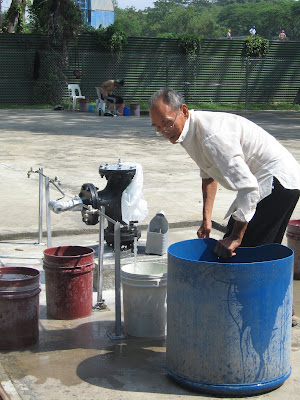
the place is open from 7.00 a.m. to 7.00 p.m. every day. the scene today is a far cry from what we witnessed in 2006 when the place was packed throughout the day, regardless of weekday or weekend. before they cemented the place and put all those retrictions in place, you could cycle or even drive and park right next to the hot spring.


Thursday, April 2, 2009
belimbing assam

there is no english name for this fruit but the belimbing assam is a little similar in appearance to the star fruit. the only differences are the size and taste; it is smaller and more sour than the star fruit. apart from this, belimbing assam is also distinguishable by its smooth, unridged, yellowish-green skin, looking a little like a pickle. juicy and acidic, this fruit is used in singapore and malaysia for making pickles which is known in malay as "sunti"; in curries; and stewed as a vegetable.

unlike the star fruit, belimbing assam has less market value and is not exported. it is normally grown in the yard for home use. the belimbing is generally regarded as too acid for eating raw, but in costa rica, the green, uncooked fruit is prepared as a relish which is served with rice and beans. sometimes it is an accompaniment for fish and meat. ripe fruits are frequently added to curries in the far east.
the juice is popular for making cooling beverages in the order of lemonade. mainly, the belimbing is used in place of mango to make chutney, and it is much preserved. to reduce acidity, it may be first pricked and soaked in water overnight, or soaked in salted water for a shorter time; then it is boiled with much sugar to make a jam or an acid jelly. the latter, in malaysia, is added to stewed fruits that are oversweet.
there are three of this fruit tree growing on the patch just next to my block. they form part of the landscape and were planted even before we moved in in 1998. no one seems to be harvesting the fruit. sometimes, however, we do see the foreign workers helping themselves to the fruit. after all, if they are not picked, they go to waste.


the belimbing can be cooked with sambal tumis or sambal mix. wash the belimbing. slice off a bit of the top to remove the stalk. cut the belimbing in half. soaked in hot water. drain the water. add lots of sugar to the belimbing. mix well. fry chopped onion, then add in the sambal paste. add in the belimbing. you may add prawns for the extra flavour. my malay friend, a former colleague, says: sedap, with mussels.


the finished product
Wednesday, April 1, 2009
sneaking into a palace in s'pore


 this morning, three daring men and one brave woman sneaked into the sultan's palace. the gate was padlocked and the sharp spikes were there to deter us from climbing. there was no guard or sentry.
so, we slipped in through a narrow opening at the side, between the post and the fence. someone must had paved the way for us and others by forcing the fence to one side.

once there was a road leading from the gate to the sultan's house. today, much of the road has been covered by creepers, so it has become more like a track. the walk from the gate to the palace made us realise the expanse of the place.

this old and bald tree was an indication of the state and age of the building that we were looking for.


it was certainly in a worse shape than the bare tree, stripped of most of its one-time fine covering and trimmings, it was in a real run-down condition. however, the kitchen and the servant quarters looked quite respectable, at least from the outside.

the bull-dozers are not far from its door-steps. soon, what the fire could not totally destroy nor the bombing by the japanese, that job would be completed by the bull-dozers.


i think this once grand building that we explored today is the istana woodneuk and not the tyersall house. most of the tiles that we saw lying around on the ground and near the roof were blue in colour. according to records, the tyersall house had a red roof.

picture from the national archives of s'pore
you can read more about the tyersall house and istana woodneuk here.
Subscribe to:
Posts (Atom)


