Wednesday, August 20, 2008

sex education of some sort (ra)


it is not like we - the kids of the 50s or 60s - were totally in the dark when it came to sex. yes, generally, most parents would not talk about this topic openly, and many still do not, but we were sometimes treated to mating performances in the open, right at the village square. we may not have formal sex education but we had opportunities to watch formal sex acts in the raw.

first, the male would sniff the rear of the female. when the female was ready, she would lift her tail to the side and strut her legs. the male then proceeded to mount the female. most seemed to lack practice as it would normally take several attempts before penetration occurred.

when penetration took place, the female would sometimes howl. then after a while, it would appear that the two dogs were locked tightly together. the male would then turn around and the two would end up facing the opposite directions. they did not remain still on the spot but tended to move around as a pair. sometimes they would pull in opposite directions but the thing would not be dislodged.

they would remain locked in this state for quite a while. that was when the sadistic nature of man would kick in. maybe, man could not understand why they could be engaged for more than half an hour or so. some onlookers would make attempts to break up the union by beating the dogs with sticks, throwing stones at them or pouring water (i don't know if it was hot water) over their bodies.

these days, such displays are indeed rare because there are no more strays running around the neighbourhood.

Tuesday, August 19, 2008

pangolin in the ground


with a dead pangolin recently in the news, i thought of my kampong days when i came across one burrowed in the ground, across the drain near my house. i cannot remember what i was looking for that day when i came across this scaly creature in the hole on a mound. i must have been scared stiff because i thought it was an enormous snake.

it was not uncommon to find snakes around the house in a kampong. once we found a colourful coral snake, early in the morning, on the cement patch just outside our home. i think the snake, though small, was a venomous one.

after i had described my find at the mound to some neighbours, one brave one went to check it out. he came back to report that it was an ant-eater and later on went back to dig it out of the burrow. i have no idea what he did with it. until then, i was not aware that ant-eaters existed in singapore.

Monday, August 18, 2008

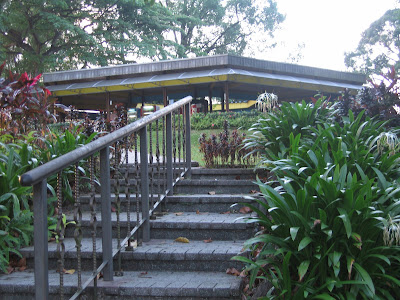
the pavilion and ziz-zag bridge of macritchie

the pavilion, ziz-zag bridge and the tea kiosk of macritchie reservoir park must have been around for at least forty years, together with the water-fountain that is still functioning.

the tea kiosk, up on the hill, is the only place where you can get food at the park.

one of the old attractions that is no longer around is the floral clock which i blogged about earlier this year.

more students than genuine park visitors have traversed the bridge when making their way to the start of the cross-country running route. until a few years back, macritchie was the favoured venue for the inter-school cross-country races. lately, they have tried holding them at alternative sites like the old turf club, sentosa and this year, the botanic gardens.

the pavilion, which used to host musical performances on sundays in the past, can now be accessed by members of the public. the place used to be locked up when not in use but these days anyone can walk into the performing area.

macritchie sure holds some fond memories for a lot of singaporeans for a variety of reasons.

Sunday, August 17, 2008

roadside fruit trees of lim chu kang (3)


the jambu mawar (rose apple) trees are also found along neo tiew crescent as well as along one of the lane 6s - there are lanes 6, 6c, 6d and 6f. i am surprised that quite a number of adults have neither seen nor tasted its fruit. as a boy, i would help myself to this fruit on my neighbour's tree.


surprisingly, not many mango trees have been planted at lim chu kang. in fact, i have come across only three mango trees in the whole area. could they have been planted by mistake? over at sungei tengah end, the road is lined by many mango trees.

on the other hand, the langsat appears to be the most dominant tree among the varieties of roadside fruit trees at lim chu kang. the langsat's fruiting season usually coincides with the durian and mangosteen, sometime in the middle of the year.

the surinam cherry is not a common fruit tree. i do not think many singaporeans have tasted its fruit. when the fruit first appears on the tree, it is yellow. it becomes bright red when it is ripe. you should pluck it only when it is so ripe that a touch by your hand will cause the fruit to fall. you will come across some of these trees along the sides of lim chu kang lane 4.

the butterfruit is native to the philippines. a medium to large evergreen, its dense canopy reaches to a height of 25 m. its slightly scented flowers produce fruits which ripen from a pink to a deep red, and is usually eaten raw. characteristically, the fruits are covered with short reddish-brown, silky hairs which are slightly irritating to the hands.

Saturday, August 16, 2008

catching freshwater eels in the stream


when we first moved into the kampong, the stream that flowed by the side of our house was not paved. before it was realigned and before it became a drain, there were more creatures making their home in it. besides, the common longkang fish - the guppies , there were tubifex worms, other types of fish, catfish and eels. eels are an order of fish although they look like snakes.

i seldom saw eels in the day. i think eels are nocturnal and prefer to hunt at night but once in a while you might spy a stray one sticking its head out of its hole at the side of the stream. most of them were about 50cm long, although i have seen longer ones. female eels tend to be bigger than their male counterparts.

it was not easy to catch the eel as it was quite slimy to the touch. we would use a fishing hook attached to a line and supported by a length of stick. we used earthworm or meat as bait. we would look for holes or gaps at the sides of the stream and push the stick with the hook into the opening. then we made a clucking sound and would wait for the belut (malay for eel) to take the bait.

even when the eel took the bait, it was not a forgone case because it would withdraw into its pit deep in the ground. it was a rare time that we managed to win the struggle and haul the eel out of the water.

i just cannot remember what we did with the eels that we managed to catch. however, i do remember seeing eels being sold by this man who would come around with a basket on the back rack of his bicycle. he would have these slimy creatures in the basket; there was not much water in the round tray at the bottom of the basket as eels can survive without water for extended periods of time.